

GLENN NYE heads the Center for the Study of the Presidency & Congress. He recently returned from a trip to Ukraine.
Ukrainian defenders have earned their reputation as the world’s most skilled drone and counter drone force. More than four years into Russia’s full-scale invasion, Ukrainian military units have developed an incredibly fast innovation loop, responding tactically to lessons learned against a determined adversary and constantly updating their methods to stay one step ahead. The result is evidenced in their ability to hold back a much larger force while also developing the capability to strike deep into enemy supply lines and strategic industrial targets that support the continued Russian assault. Ukraine’s success owes as much to the domestic defense production ecosystem as to the brave defenders who hold the lines.
The Frozen Front Line as Live Laboratory
The front line between Russian invaders and Ukrainian defenders is a brutal environment, in ways more reminiscent of World War I trench dynamics than World War II-style maneuver warfare. Within 20 kilometers on each side, movement in large vehicles is nearly impossible due to constantly patrolling first person view (FPV) attack drones. Soldiers carry on foot what cannot be transported with small aerial (UAV) or ground (UGV) drones. Many soldiers remain in trench conditions for over 100 days at a time.
The front line is also a world-class defense innovation lab, serving as a large and active range for real-time testing of defense technology. By necessity, Ukrainian units methodically improve the capability of their drones and the mechanics of countering Russian tech, while the adversary races to gain advantage. Adaptation takes many forms:
Transportation of troops and supplies is shifting from armored vehicles to smaller, nimble SUVs
Packaging of drones is more efficient to make each treacherous delivery of containers carry more units
Drones are constantly redesigned to change radio frequencies for guidance
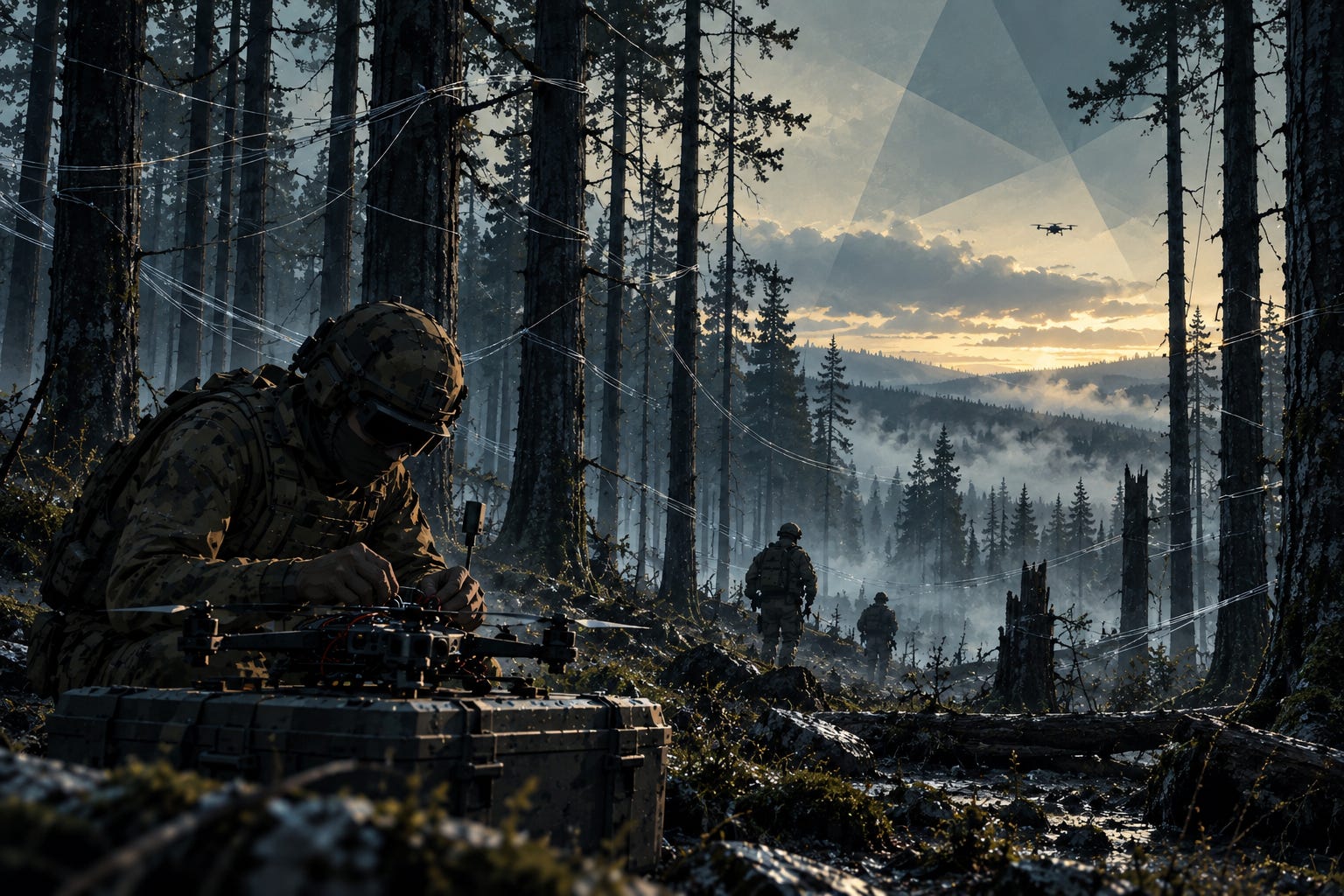
Fiber optic cables are deployed to avoid jamming (some forests are literally covered in cables)
Increased modularity so accessories can be quickly swapped out and upgraded
Repositioned or reshaped antennae, increased battery life, and improved thermal imagery, sensor mapping, and propeller design
Some of these adaptations take place near the front, as forward deployed soldiers 3D print newly designed parts for immediate use. Some are supported by an array of private citizens, such as Ukrainians who hand make or print drone parts at small scale in their apartments for delivery to collection points. Great credit goes to the larger array of professional domestic manufacturers who respond in real time to demand signal from units in the field as they collect data on what works in practice and who adapt rapidly to meet the ever-changing supply needs. They make up a dynamic and decisive part of Ukraine’s industrial base.
Competition on Both Sides of the Market
Ukraine benefits from a citizenry dedicated to victory in the defense of their country and a high degree of technical education and talent. It also benefits from some wise procurement policies. Ukraine’s domestic arms production base—largely focused on drones but also engaged in production of electronic warfare and communications systems, charging stations, and heavy weapons components—is a marvel of distribution. By necessity of war, Ukraine’s defense production is spread across a wide array of relatively small production and R&D locations. It cannot have its defense production centralized in larger facilities that would be easy for Russian forces to locate and strike.
Visits made by guests to these facilities often involve meeting up at an ambiguous predetermined map coordinate before being spirited away to the actual physical location for operational security. Numerous small companies exist to supply military units with weapons systems, many of which are now made with 90 percent Ukrainian-sourced components.
Even more interesting, Ukrainian military brigades have a significant degree of budget autonomy to select what types of drones, electronics, and other equipment they want to buy from the marketplace. Thousands of vendors compete to rapidly respond to conditions that units communicate from the field, while units compete to select and field the best products, rather than wait for the Ministry of Defense to select a one-size-fits-all capability. Units are rewarded with additional budget when they successfully field their selected products. Producers are rewarded with additional sales when their products create effects on the battlefield, and they do not have to wait to win a centralized government tender to offer many products to units.
The Ukrainian government-created online marketplace, Brave1, serves as a matching entity between brigades and industry, with little red tape. The entire marketplace thus reacts to battlefield feedback in real time. What the industrial base lacks in economy of scale from large, centralized production, it makes up in rapidly adaptive production that is constantly fitted to the warfighter need. The collective result is product adaptation loops that close and innovate on drone technology in weeks rather than months or years. This loop is keeping Ukraine in the fight on the front line, while also domestically producing long-range strike drones that are increasingly capable of evading intercept and navigating to strike refineries and logistics locations deep inside Russia.
To be sure, Ukraine remains partially reliant on assistance from partner countries and private and NGO supporters for weapons and technology. For example, Starlink provides a critical support capability to Ukrainian drone guidance and communications, and Western interceptors are currently vital for the defense of Ukrainian cities against incoming ballistic missiles. Even with perfect execution and efficient allocation of national resources to the fight, Ukraine would still need (and deserve) assistance from Western partners, who also stand to benefit from access to real-time feedback on defense capabilities and methods. Ukraine’s imperative to efficiently deploy productive capacity, however, does offer some valuable insights.
Takeaways for American Defense Production
It would be difficult for the U.S. to match one condition driving the Ukrainian innovation loop: the immediate existential urgency of war. Ukraine cannot afford to attempt to defeat this invasion by training and deploying soldiers in greater numbers than Russia. It simply must win the perpetual tech production and innovation contest. Not only must it rapidly produce technological innovations that give its forces an edge on the front, but it must also automate the battle space quickly to save precious and scarce human resources from a war of human attrition. It must do this with an economy a fraction the size of ours, and with an industrial base that was not previously primed for war.
Not all of Ukraine’s lessons would readily apply to the U.S. defense base and our particular advantages. But the nimble application of competition between suppliers on one side of the market and between military brigades on the other side provides a useful conceptual lesson. Ukraine is building product for a war it is fighting now. The U.S. is largely preparing to deter future conflict (while also learning lessons about munitions production and readiness in the Persian Gulf). Still, for many products, we can introduce greater service- and unit-level autonomy to deploy budget against the full American marketplace of large and small companies to field and test more efficient ways to rapidly build a nimble and deterrent force.
Adopting Ukraine’s best drone technology today would be interesting but soon obsolete. Adopting some of the speed with which their industrial base systemically adapts to the changing nature of war would prime the American defense ecosystem for success in any future conflict.
