


SHANE ROCKETT is the Commercial Lead at Sable, a team of AI researchers and engineers dedicated to giving AI real-time computer use, vision, and voice capabilities. They are hiring world-class engineers. Inquiries can be sent to roles@withsable.com.
ABBY CARR works in Strategic Engagement at Palantir Technologies. She is a fellow at the Foundation for American Innovation.
On August 19, 1812, the frigate USS Constitution spotted HMS Guerrière southeast of Nova Scotia. Captain James Dacres of the Guerrière was eager to fight. The Royal Navy had not lost a single-ship frigate action to an equal opponent in over a decade, and Dacres had reportedly issued a challenge to any American frigate willing to accept. Constitution’s Captain Isaac Hull obliged.1
Captain Hull closed to within half a pistol shot before unleashing his first broadside. Within fifteen minutes, Guerrière’s mizzenmast was gone. Cannonballs struck Constitution’s hull and bounced off. A sailor watching them ricochet into the Atlantic reportedly shouted, “Huzzah, her sides are made of iron!”2
Guerrière eventually lost her mast and surrendered. The action lasted roughly thirty minutes, and it was the first of a streak. United States defeated Macedonian. Constitution came back and took Java. An infant navy, barely eighteen years old, was beating the greatest fleet in the world, ship for ship.3 George Canning told the House of Commons that the sacred spell of the Royal Navy’s invincibility had been broken.4
Why Dacres failed to account for his disadvantage is worth examining. Part of the answer lies in the fact that frigates of that day simply weren’t supposed to be as large or powerful as Constitution. She outmanned Guerrière’s crew 456 to 311, and her broadside outweighed her opponent’s by about fifty percent.5 Constitution and her sister ships broke the established model of a frigate. She was bigger, heavier, and hit harder. That advantage, however, raises a deeper question: how was it that only the new American frigates could carry so much armament?
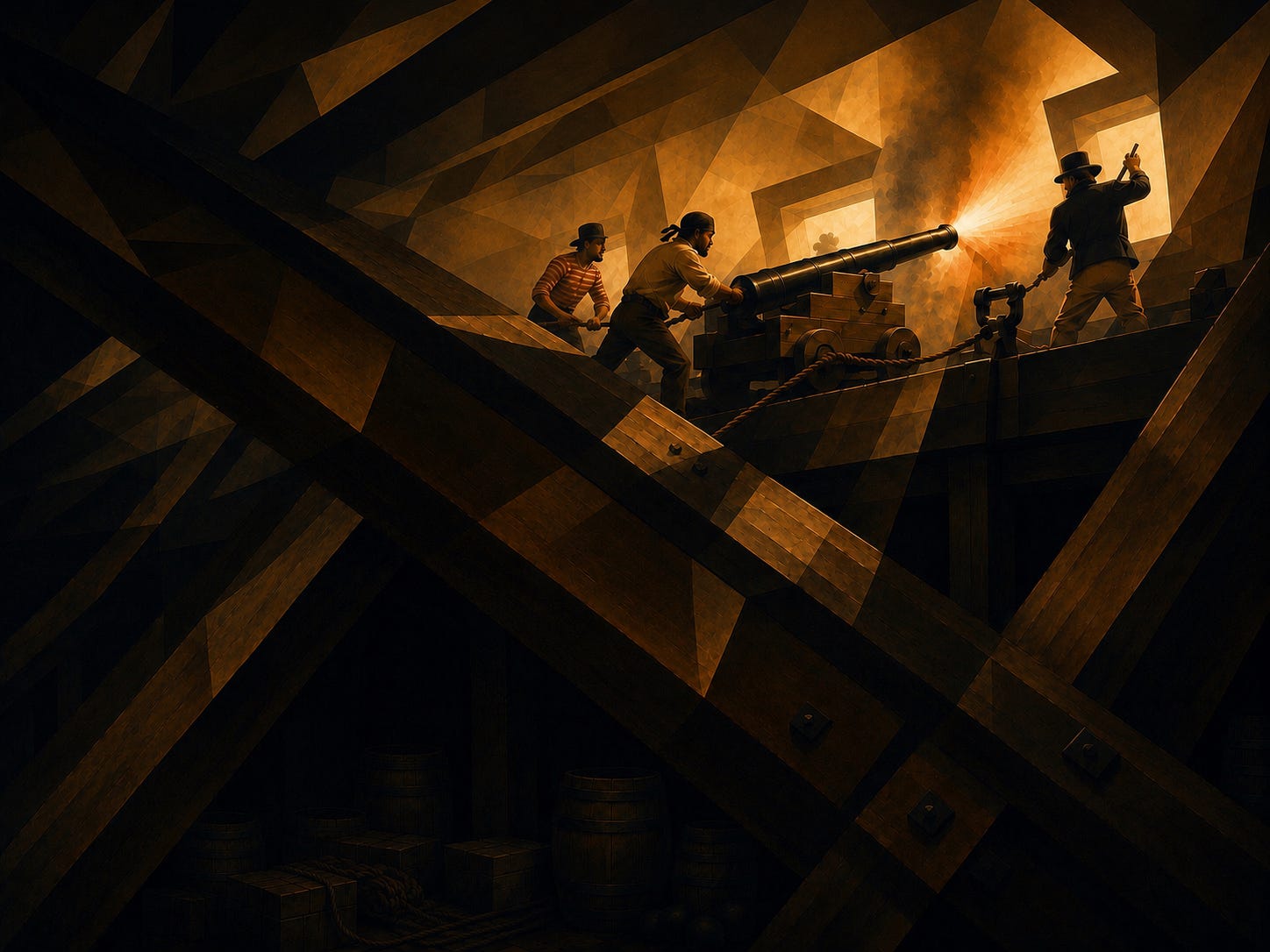
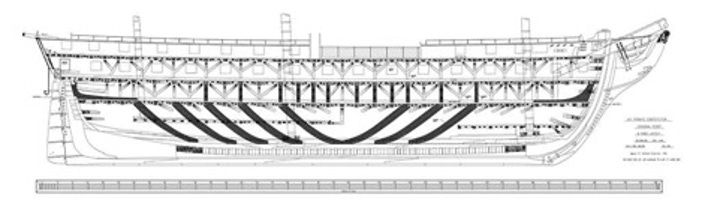
Deep inside Constitution’s hull, six pairs of heavy timbers ran diagonally along the length of her sides. They never fired a shot, and no painting commemorates them, but these “diagonal riders” let Constitution and her sister ships carry an armament no other frigate could.
Diagonal riders appear across centuries and domains as a pattern: a constraint-breaking innovation that remains invisible during the deployment of a capability. Their impact, and the consequences of removing them, are understood only by the people who know they are there in the first place.
Below the Gun Deck
Joshua Humphreys, the man who built the original frigates of the U.S. Navy, has been covered by First Breakfast before.6 He had never seen a European ship of the line but he had worked on over 300 vessels since the age of twelve. His frigate designs were so novel that his guildsmen unanimously rejected them.7 What is less well known is the specific structural innovation that made his vision possible.
The infant U.S. Navy was not resourced to build a thousand ships; instead, Congress directed Humphreys to build a mere six frigates. Typical frigates of the era carried their guns on a single deck, favoring speed over firepower in a lean build. Humphreys’ plan was to break that mold; he would load his frigates with a much heavier armament than was the norm: bigger guns and more of them on a longer deck.
The physics were hostile to Humphreys’ concept. A hull long enough to carry that many guns bows under its own weight. The ends droop while the more buoyant middle rises, bending the keel, and destroying the ship in a process shipwrights call hogging. This was a well-documented failure mode that every shipwright in the Atlantic understood and accepted as a hard constraint on what a frigate could be.8
Other navies addressed hogging with short diagonal braces that functioned as local patches, but Humphreys took the idea further than anyone before him. His diagonal riders were thick planks of timber running in six pairs from the keel upward through the frame at steep angles, spanning much of the lower hull. The extended hull held under weights that should have broken it, allowing a significantly larger armament to fit aboard a frigate and fire upon Guerrière during her duel with Constitution.
Nobody on Guerrière’s deck thought, “We are being beaten by superior keel reinforcement.” Their attention, and most of the commentary since, has focused on Constitution’s armament. But it was the diagonal riders, unseen and uncredited, which made that armament possible.
The Lost Sixth Frigate
Not all six frigates got diagonal riders.
Humphreys’ British-trained assistant, Josiah Fox, had long disagreed with his boss’s approach. When Fox was given control of the sixth frigate, USS Chesapeake, he altered the design, scaling down the ship’s armament and changing the dimensions.9 Fox is known to have disagreed with Humphreys specifically on the diagonal riders, and historians conclude he almost certainly left them out.10 The logic of what follows is worth tracing carefully because it illustrates exactly how diagonal riders tend to disappear.
Without the diagonal riders, the Chesapeake’s hull could not carry the same armament as her sister ships, leaving her closer in firepower to a standard European frigate. While the other American frigates overpowered their opponents with a class of firepower never before seen on a frigate, Chesapeake fought on roughly equal terms.
Constitution could actively seek engagements because she outgunned any enemy frigate and could outsail anything that outgunned her. Chesapeake had no such margin, so every engagement she entered was a fair fight.
When HMS Shannon captured her off Boston in 1813—the only single-ship loss among the original six frigates—the engagement was decided in minutes by command and crew quality.11 Those variables only mattered because Chesapeake lacked the advantage that made her sister ships’ victories closer to foregone conclusions.
Humphreys drew his own conclusion. In 1827, when Fox was claiming credit for the frigate designs in newspaper interviews, Humphreys wrote of the Chesapeake: “She spoke his talents. Which I leave the Commanders of that ship to estimate by her qualifications.”12 Translation: if Fox wants credit, he can have the Chesapeake. The men who sailed her can judge whether that’s a credit worth claiming.
Humphreys himself framed it as a dispute over credit and craftsmanship, rather than internal bracing. The diagonal riders were invisible even in the argument between the two men who understood them best. Everyone saw an unlucky ship, yet no one asked what was missing from inside the hull.
In Search of Diagonal Riders
Diagonal riders did not disappear with the age of sail. Similar examples exist throughout history. The platforms and constraints change, but the pattern remains: hard limits overcome by hidden workarounds result in capabilities that tilt the balance in a conflict.
Leading up to the Battle of Britain, British Supermarine Spitfires were being outrun by German Messerschmitt Bf 109Es. The problem was “knock,” or the pre-detonation that occurred when the standard 87-octane fuel ignited in the engine. RAF pilots could only go so fast before their engines started to shake themselves apart.13
Three years earlier, Air Commodore Rod Banks had pushed for the adoption of 100-octane fuel, arguing that it could prove decisive in the early stages of a war. He was rejected because wartime supply could not be guaranteed from American refineries.14 But across the Atlantic, Jimmy Doolittle, the man later famous for his Tokyo raid, had convinced his colleagues at Shell Oil to invest in 100-octane refining at a scale no customer yet needed. Mocked as “Doolittle’s million-dollar blunder,” his bet helped make the fuel cheap and abundant by the time war broke out.15 Only months before the war, the first tanker of green-dyed British Air Ministry 100-octane (BAM 100) was shipped to England, where it was secretly stockpiled.
By the time the Battle of Britain began, the RAF had modified its fleet to handle the new fuel.16 Using BAM 100, the Spitfire gained a remarkable 25 mph at sea level and 34 mph at ten thousand feet.17 The Germans did not even realize the source of this change until they found fuel samples from a downed Spitfire in Belgium. Once they knew, they couldn’t exploit the knowledge; the Germans’ best fighter, the 109E, was not equipped to use this superior fuel.18 Due to its classification at the time, and the tendency to focus on platforms rather than supporting technologies, BAM 100 receives little attention in the popular version of the Battle of Britain.
Diagonal riders were present in the Cold War, as well. In the late 1950s, Kelly Johnson’s Skunk Works was designing an aircraft so fast that no interceptor or missile could touch it. At those speeds, a standard aluminum frame would heat up past the point of failure. Titanium, however, would not. Despite the abundance of titanium ore, aircraft-grade refined titanium was expensive and rare. It still is. The world’s largest exporter of refined titanium at the time? The Soviet Union.
Not ones to let the Cold War stymie a supply chain, the CIA set up shell companies and third-party intermediaries to purchase enough Soviet titanium to build the entire fleet of aircraft. The Soviets never learned who they were supplying.19 Sixty years later, the SR-71 Blackbird’s speed record still stands. The plane is iconic, but the titanium airframe that made it possible receives far less attention.
Diagonal riders continue to break constraints in modern platforms, as well. A fully loaded F-16 carries enough fuel for about 45 minutes of flight on combat ops. Adding external fuel tanks to the wings gains range, but only at the expense of payload and maneuverability. The constraint-breaker is a Boeing 707 with 200,000 pounds of jet fuel in its belly, known as a KC-135 Stratotanker. Since its first major usage in Vietnam, the Stratotanker has enabled every major American air campaign via mid-air refueling.
During Desert Storm, a typical strike package consisted of 75 aircraft.20 One in five was a flying gas station.21 In 43 days of Desert Storm, tanker crews made just under 46,000 refueling contacts, without missing a single rendezvous.22 These tankers are largely absent from the “video game war” version of Desert Storm that the public knows (laser-guided bombs threading ventilation shafts and night-vision footage on CNN). In Desert Storm, the F-16 was the weapon, but the tanker was the diagonal rider that let it reach its target.
In each of these examples, a constraint was accepted as given until someone broke it in almost total obscurity. The visible capability received all the attention while the constraint-breaker disappeared into the layers of the platform.
What a Diagonal Rider Is—And Isn’t
Not all foundational technologies are diagonal riders. Diagonal riders must be both constraint-breaking and invisible in the performance of a capability.
Aircraft carriers broke the constraint of dependence on land bases. But they are arguably the most visible symbols of American military power. Encryption and code-breaking technology might have started as a diagonal rider, but now Bletchley Park is a tourist destination and the subject of movies.
Other foundational technologies are invisible but optimize an existing capability, rather than truly breaking the constraints of a platform. Beginning in the 1760s, the Royal Navy clad warship bottoms with copper. “Coppered” ships maintained their speed over longer deployments and spent less time in dry dock, but copper was a performance improvement rather than a generational leap forward.23 A good test is “What would happen if this technology were removed?”
The defining threshold is the combination of necessity and invisibility. Necessary but visible technologies are known enablers. Invisible technologies that aren’t constraint-breaking are background details. A diagonal rider is both: required for the capability to exist and absent from the story told about that capability.
Why This Matters
Companies building visible end items may attract the most press and capital, but they risk converging toward parity because everyone can see and compete on visible capabilities. In an acquisition system built around requests for an end item (e.g., “I need a drone”, “I need a satellite”), companies building diagonal riders can be too easily overlooked.
Humphreys built a better frigate by asking what would have to be true to fit a ship of the line’s armament aboard one. Equivalent opportunities exist today. A founder who identifies an implicitly accepted constraint and breaks it is paving the way for visible capabilities to exist, and a healthy defense ecosystem must innovate at least as much on diagonal riders as on the visible platforms they enable.
The same logic applies in reverse. If successful allied capabilities have diagonal riders, so do adversaries’ capabilities. Those diagonal riders are often less protected than the platforms they support, because they are invisible even to the people who depend on them. A platform stripped of its diagonal rider reverts to the constrained state, the way Chesapeake reverted to just another frigate. Analyzing an adversary’s capabilities without identifying its diagonal riders is doing half the work.
Humphreys’ diagonal riders were invisible in the battle and largely invisible in the thirty-year argument over who deserved credit for the ships. They were also the reason the ships won duels. We need better language for this kind of technology. We offer: the diagonal rider.
The Royal Navy’s dominance in single-ship frigate actions before 1812 is well documented. British officers and crews had been fighting and winning at sea continuously since 1793, and no equally rated opponent had defeated a British frigate in a one-on-one engagement for years prior to the American victories. The shock of the 1812 losses was severe enough that in July 1813, the Admiralty issued orders forbidding British frigates from engaging their American counterparts without at least a two-to-one advantage. The Dacres sign is one of the most retold details of the engagement; variations appear across accounts. The exact armaments each ship carried are hard to identify, given fluctuations during a deployment, but Constitution having roughly 200+ pounds heavier broadside is supported by crew logs and historians. See Ian W. Toll, Six Frigates: The Epic History of the Founding of the U.S. Navy (New York: W.W. Norton, 2006); Theodore Roosevelt, The Naval War of 1812 (1882).
The origin of the “Old Ironsides” nickname during the Constitution vs. Guerrière engagement is one of the most retold moments in American naval history. The exact words and attribution vary across accounts, but the cannonballs-bouncing-off-the-hull scene is well attested. See Toll, Six Frigates.
The Naval Act of 1794 authorized the construction of the six frigates; the Department of the Navy was formally established in 1798. The Continental Navy, created in 1775, was disbanded after the Revolution and its ships sold off by the mid-1780s, leaving no institutional U.S. Navy for roughly a decade. Officers like John Barry and Richard Dale carried experience forward from the Continental service, and the design lineage was not built from zero. But the organizational, financial, and industrial infrastructure of the navy that fought in 1812 dates to the 1794 Act and the years immediately following. “Eighteen years from its founding act” counts from that legislation. See Toll, Six Frigates, chs. 1–3.
Jeremy Black, “A British View of the Naval War of 1812,” Naval History Magazine, August 2008, Vol. 22, No. 4. Black cites it as footnote 6 in the article, attributing it to Canning on February 18, 1813 in the House of Commons.
A knowledgeable reader may note that razéed two-deckers (ships of the line cut down to a single gun deck) did carry comparable or heavier armaments. The distinction is that razées were conversions of existing hulls, not purpose-built frigates designed from the keel up to sustain those loads. The Royal Navy began building razées specifically in response to the American frigate victories of 1812, converting old 74-gun third-rates into 58-gun heavy frigates to overpower Constitution and her sisters. Humphreys’ achievement was engineering a purpose-built frigate hull that could bear the weight of broadside previously associated with capital ships: Constitution’s broadside as built was roughly 528 pounds, compared to 342 for a standard European 38-gun frigate. That structural margin came from the diagonal riders, not from cutting down a larger vessel. See Toll, Six Frigates; Roosevelt, The Naval War of 1812.
Humphreys’ early biography: born June 17, 1751, in Haverford, Pennsylvania; apprenticed to a ship carpenter in Philadelphia; took over the yard after his master’s death. His disownment by the Quakers for constructing warships is noted in multiple sources. See Historical Society of Pennsylvania, Joshua Humphreys Papers (Collection 0306); USS Constitution Museum, “Humphreys’ Marvel”; Hugh Zabriskie, “Joshua Humphreys, Frigate Forger,” First Breakfast (January 2025).
Humphreys' strategic rationale for the super-frigates: ships powerful enough to overpower any frigate afloat but fast enough to escape ships-of-the-line. The rival shipwrights’ unanimous rejection, the detail that Humphreys had never seen a European ship-of-the-line, and his experience with 300+ vessels are documented in Zabriskie, “Joshua Humphreys, Frigate Forger.” See also Humphreys’ own correspondence as preserved in the Historical Society of Pennsylvania collection; Britannica, “Joshua Humphreys.”
The diagonal rider system: Commander Tyrone G. Martin, USN (Ret.) and Commander John C. Roach, USNR, “Humphreys’s Real Innovation,” Naval History Magazine (April 1994, Vol. 8, No. 2). This is the definitive technical treatment, documenting the six pairs of full-length, pre-stressed diagonals, the distinction from conventional short braces used by other navies, and noting which of the six frigates received them and which did not. Martin and Roach note that David Stoddert, constructor of Constellation, was ordered to omit the diagonals at Captain Truxtun’s request, and that Fox “undoubtedly left them out” of Chesapeake. On hogging as a well-understood constraint in Atlantic shipbuilding, see also Toll, Six Frigates, ch. 2
Fox’s alteration of the Chesapeake design from 44 guns to 36: see “USS Chesapeake (1799),” Wikipedia; “Original Six Frigates,” Wikipedia; Toll, Six Frigates. and Humphreys’ 1827 quote (“She spoke his talents...”). Possible explanations include timber diversions to complete Constellation and Fox’s own design preferences.
On Fox’s background, credentials, and disagreements with Humphreys over hull length and bow sharpness: see “Josiah Fox,” Wikipedia; Toll, Six Frigates, pp. 52–54; “Chapter 6: The Rivals and the Enemies,” Early Philadelphia Shipbuilding.
Chesapeake as the “runt of the litter,” her reputation as an unlucky ship, “USS Chesapeake (1799),” Wikipedia. USS President was also captured by the British in January 1815, but the circumstances were categorically different. President had grounded on a sandbar leaving New York Harbor and sustained serious damage to her keel and rudder before the engagement began. She was then pursued and overwhelmed by a squadron of four British ships. Chesapeake remains the only one of the original six lost in a one-on-one frigate action.
Fox’s 1827 newspaper claims from Ohio: In August 1827, Humphreys’ son Samuel alerted his father to a newspaper article in the National Journal reprinting an item from the Wheeling Gazette, in which an aging Fox claimed credit for designing the three major frigates. See “Chapter 6: The Rivals and the Enemies,” Early Philadelphia Shipbuilding.
Gavin Bailey, "The Narrow Margin of Criticality: The Question of the Supply of 100-Octane Fuel in the Battle of Britain," The English Historical Review, Vol. CXXIII, No. 501 (April 2008), pp. 394–411. DOI: 10.1093/ehr/cen007. This is the definitive peer-reviewed source. Bailey works from Air Ministry records at the Public Record Office (now The National Archives, Kew). Covers the pre-war planning, stockpile buildup, the February–May 1940 decisions to begin operational use, and the modifications to boost limiters. Bailey himself has publicly confirmed that 100-octane was in widespread use in Fighter Command During the Battle of Britain.
Air Commodore F. R. Banks, I Kept No Diary: 60 Years with Marine Diesels, Automobile and Aero Engines (Airlife Publications, Shrewsbury, 1978). Banks' own account of his January 1937 paper urging 100-octane adoption, the Air Ministry's initial rejection, and the subsequent conversion of the Merlin. His Appendix II on fuel is available digitally at wwiiaircraftperformance.org.
Benjamin W. Bishop, “Jimmy Doolittle: The Commander Behind the Legend,” Drew Paper No. 17 (Maxwell AFB, AL: Air University Press, February 2015), ISBN 978-1-58566-245-6.
"Merlin II and III Use of +12 lbs./sq.in Boost Pressure – Alterations and Precautions." Air Ministry's Air Publication A.P.1590B/J.2-W. 16. London: Air Ministry, 1940. Primary source on the modification they made to the engines which was basically authorizing pilots to boost twice as much (up to +12lb/sq inch instead of ~+6) after making some modifications
Royal Society of Chemistry, “The secret fuel that made the Spitfire supreme” (May 2009).
https://www.nytimes.com/1978/12/03/archives/new-jersey-weekly-4-who-helped-win-battle-of-britain.html?smid=url-share Account of the Germans finding a downed Spitfire and being frustrated they could not use the BAM 100 fuel: The New York Times, “Who Helped Win Battle of Britain”
Ben R. Rich, Skunk Works: A Personal Memoir of My Years of Lockheed.
Strike package composition figures: “Gulf War Air Power Survey Summary Report.”
The forty-three days of DESERT STORM included 15,434 tanker sorties, an average of 358 every day. The refuelers logged 60,000 flying hours and made 45,995 fueling contacts, an average of three contacts per sortie. Approximately 110.2 million gallons of fuel (716 million pounds) were pumped through tanker booms or hose-reel sets to their receivers. One of the most interesting—indeed, truly provocative—statistics to emerge from this forty-three–day operation is that on any given day of DESERT STORM, 18 percent of the airplanes in the air—almost one-fifth of the force—were tankers. https://www.govinfo.gov/content/pkg/GOVPUB-D301-PURL-LPS47711/pdf/GOVPUB-D301-PURL-LPS47711.pdf
Mark Hasara, Tanker Pilot: Lessons from the Cockpit (2019). Hasara, a KC-135 pilot during Desert Storm, recounts the four-ship tanker cell that penetrated 40 miles inside Iraqi airspace to refuel 32 F-16s that had not been refueled pre-strike.
“Copper-Bottoming the Royal Navy,” U.S. Naval Institute.

