

RYAN MUSTO is a venture capitalist leading investments in deep tech and defense tech with a focus on maritime systems, critical materials, and advanced manufacturing.
Every generation or so, a new theater of geopolitical competition takes shape before most people realize it’s a theater at all. The Arctic. Cyberspace. Low Earth orbit. Each time, a window opens, early movers stake their claims, and latecomers spend decades trying to claw back ground that could have been secured upfront for a fraction of the cost and effort.
The deep Pacific seafloor is the latest iteration of this story. And America is already behind. There is a telling asymmetry in how Washington thinks about the deep Pacific. The United States Navy has spent decades and hundreds of billions of dollars perfecting its ability to operate beneath those waters—tracking submarines, projecting deterrence, and mapping choke points. Washington has spent far less energy thinking about the resources that are sitting on the floor.
While Washington debates tariff regimes and domestic stockpiling strategies for land-based critical minerals, China has spent the better part of a decade quietly securing the most mineral-rich real estate on Earth. The window for the United States to compete is closing faster than anyone in the reindustrialization debate seems to realize.
The Treasure Map
Scattered across the Clarion-Clipperton Zone (CCZ)—a stretch of deep Pacific seafloor roughly half the size of the continental United States—lie trillions of polymetallic nodules packed with cobalt, nickel, manganese, and rare earths. By most serious estimates, this single geological formation contains more cobalt, nickel, and manganese than all known land-based reserves combined. These materials are needed to build electric vehicle batteries, advanced semiconductors, military hardware, and the full stack of next-generation American industrial technology. As American policymakers debate how to secure access to these resources from sources on land, vast troves are sitting on the ocean floor, largely untouched.
China is moving to exploit these resources. While the United States cycled through regulatory debates and permitting battles that kept American companies on the sideline, China’s state-owned enterprises accumulated five of the International Seabed Authority’s (ISA) roughly thirty exploration licenses—more than any other nation. American companies hold none—the United States never ratified the United Nations Convention on the Law of the Sea (UNCLOS), the treaty that governs ISA membership, effectively barring them from the process.
The ISA, the United Nations body with sole authority to grant exclusive rights to survey and eventually mine the international seabed, has been deadlocked for years finalizing the commercial mining code that regulates extraction. China’s strategy was to secure exploration licenses early, knowing they would confer priority extraction rights the moment the code was eventually settled. The ISA does not move at venture speed; China’s state capital does.
China didn’t stumble into this. It was the result of a deliberate, state-directed, decade-long strategy to corner the most important mineralogical frontier of the twenty-first century before the rest of the world fully understood what they were doing.
The United States is behind the curve in the deep Pacific, but that wasn’t always the case. In the 1970s, U.S. intelligence and naval programs secretly surveyed vast stretches of the deep Pacific seabed. The primary mission was building a classified hydrophone network to track Soviet submarines moving through Pacific choke points. But those same surveys mapped the seabed’s mineral wealth in remarkable detail. In one of history’s better ironies, the Central Intelligence Agency’s 1974 Project Azorian, which partially recovered a sunken Soviet submarine from the Pacific floor, used commercial manganese nodule mining as its cover story. The U.S. government quite literally invented the fiction of deep-sea mining to hide an intelligence operation.
The strategic intelligence gathered was extraordinary; however, the government quietly allowed it to atrophy in the decades that followed. As the Cold War wound down, the sense of urgency faded, and the institutional knowledge that America had painstakingly built simply was not maintained. It is one of the more underappreciated strategic own-goals of the late twentieth century.
The counterfactual isn’t hard to imagine: American companies were already surveying the CCZ, and Congress passed the Deep Seabed Hard Mineral Resources Act (DSHMRA) in 1980. The window was open, yet we walked away from it.
China is running the equivalent program today, openly, at scale, and supported by state-backed capital that no American startup can match. The China Ocean Mineral Resource Research and Development Association (COMRA) isn’t a scholarly curiosity shop, as its name might suggest; it’s a flag-planting operation dressed in academic clothing. Founded in 1990 with an explicit state mandate to acquire deep-sea mineral rights, COMRA registered as a pioneer investor with the precursor to the ISA in 1991 and secured its first CCZ exploration contract by 2001. Since then, it has built a dedicated fleet of research vessels and deep-sea submersibles, including its Jiaolong, which dove to 7,000 meters in the Mariana Trench in 2012. China’s 14th Five-Year Plan allocated roughly $2.4 billion to COMRA and associated deep-sea programs. In November 2024, Xi Jinping personally announced the successful sea trial of China’s first domestically produced deep-ocean drilling vessel. By 2025, Chinese state-owned corporations were conducting active commercial mining trials, with the Kaituo 2 crawler successfully harvesting nodules at depths exceeding 4,000 meters. China’s efforts have moved beyond research to a full industrial buildout. And unlike our 1970s mapping operations, it is unlikely to be quietly shelved when the political winds shift.
America missed its opportunity to take the lead in the undersea domain. That is the uncomfortable truth. But discomfort, at least, is actionable. Denial isn’t.
We can’t afford to be wrong again. This time, the tools exist to mine the seabed. The commercial and technological moment to capitalize on the subsea has materialized. The Cold War-era seabed intelligence never had a ready industrial base to capitalize on it. Today’s deep-sea mining does.
The Jurisdictional Opportunity
The opportunity here is enormous. CCZ nodules would give the United States a domestic (or at minimum friendly-waters) alternative for three minerals it currently imports almost entirely at China’s discretion: cobalt (73 percent of global demand now goes to batteries, with aerospace and defense superalloys accounting for most of what remains), nickel (essential to next-generation battery chemistries), and manganese (critical to both steel production and battery cathodes). Reducing dependence on Chinese-controlled supply chains for these inputs directly reduces the leverage Beijing holds over American defense production, EV manufacturing, and the broader reindustrialization movement.
Unlike rare-earth mining on land—which is politically toxic, environmentally contested, and takes years to permit under the best of circumstances—deep-sea mining in international waters sits in a jurisdictional gray zone. A determined administration could move the ball quickly and get projects permitted and capitalized faster than in almost any other critical minerals context. The April 2025 executive order directing the National Oceanic and Atmospheric Administration (NOAA) to accelerate deep-sea mining licensing under existing authority is proof of concept: more than ten applications arrived almost immediately. In terms of law and regulation, we could move fast here—at least by typical Washington standards.
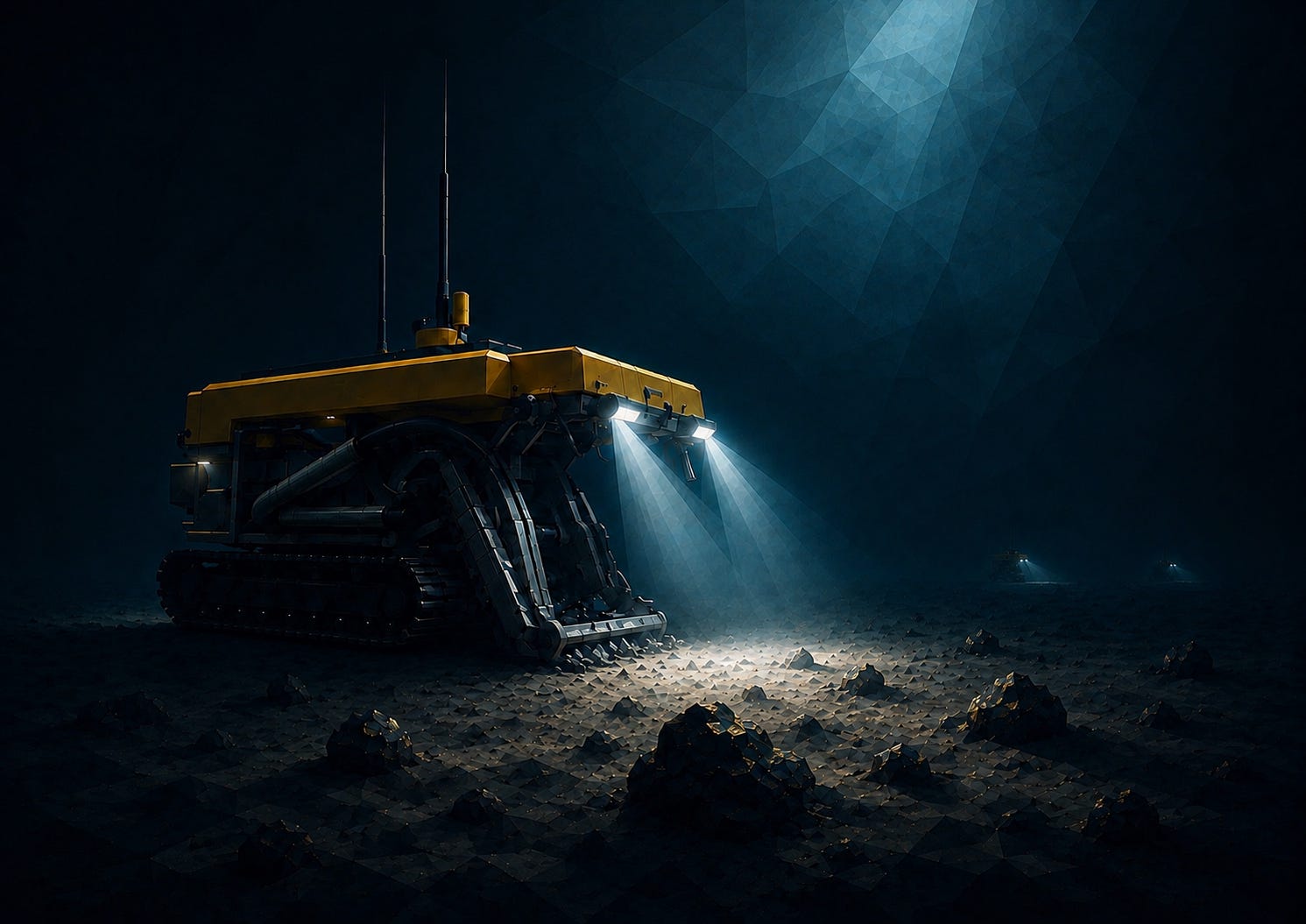
The technology required to do this is being built right now. A handful of American startups are genuinely close to changing the minerals map by developing Remotely Operated Vehicle (ROV) systems, nodule collection platforms, processing vessels, and subsea robotics. Not in a “five years away, trust us” kind of way. In a “one committed investor cohort away from demonstrating proof of concept at commercial scale” kind of way.
American industry is at the deployment capital stage—the exact moment where focused private capital has historically created the durable national advantages that government programs alone could never build. Think of it as the maritime analog to what happened in commercial space: SpaceX didn’t invent rocketry. It took existing technology, added focused capital and urgency, and transformed what was once a government monopoly into a globally competitive American industry. The deep-sea mining ecosystem is asking for the same treatment. SpaceX is now responsible for more than 80 percent of all mass launched to orbit globally. Launch costs have fallen from roughly $65,000 per kilogram to under $1,500 (a 95 percent reduction). This is a price collapse that went beyond disrupting the existing launch market by creating entirely new ones: Starlink now has 5.4 million subscribers and generated $6.2 billion in satellite broadband revenue in 2024 alone, a market that barely existed before SpaceX made it economically viable.
The same dynamic is available in deep-sea mining: a technology-driven cost collapse that unlocks an entirely new critical minerals supply chain, with follow-on effects for EV manufacturing, defense procurement, and every downstream industry that currently sits at the mercy of Chinese mineral pricing.
The first-order problem is capital, but the second-order problem is political will. American deep-sea mining startups have been unable to raise the rounds they need in part because investors rightly perceive a policy environment that is uncertain at best and hostile at worst. The ISA’s multilateral framework, designed in a more cooperative era, was never built to move at venture speed. It moves on diplomat time.
The solution isn’t to abandon multilateralism wholesale. The machinery already exists. The DSHMRA gives NOAA the authority to issue exploration licenses and commercial recovery permits for deep-sea mining in international waters, and the April 2025 executive order has already activated it. What the administration needs isn’t new law—it’s the political will to see the process through. The DSHMRA represents a unilateral U.S. track, operating outside the ISA framework precisely because Washington never ratified UNCLOS. The current administration has chosen to proceed on that basis.
The intersection of defense relevance (dual-use seabed sensing, mapping, and ROV technology), strategic minerals independence, and a sector where private capital has already laid the groundwork is precisely the kind of inflection point the United States has historically been best positioned to exploit. Will we seize the opportunity?
The Bottom Line
The seabed doesn’t make headlines the way Taiwan does. It doesn’t generate the visceral policy urgency of a tariff war or a chip export ban. But mineral control is the upstream variable that determines the outcome of many important downstream fights. Whoever controls the inputs controls the supply chains. Whoever controls the supply chains controls the industrial base. And whoever controls the industrial base wins the long-run strategic competition.
China understood this years ago. The trillions of nodules sitting in the deep Pacific won’t wait for Washington to catch up—they will belong to the power that gets there first.
