

Max Streeter is a Deployment Strategist at Palantir Technologies serving U.S. government clients.
In his autobiography, Royal Navy Admiral Percy Scott told of a letter written by a fellow naval officer that breached all protocol. In November 1901, a forty-two-year-old American lieutenant bypassed his superiors and wrote directly to President Theodore Roosevelt. Scott called it “a gross act of insubordination for a junior officer.”
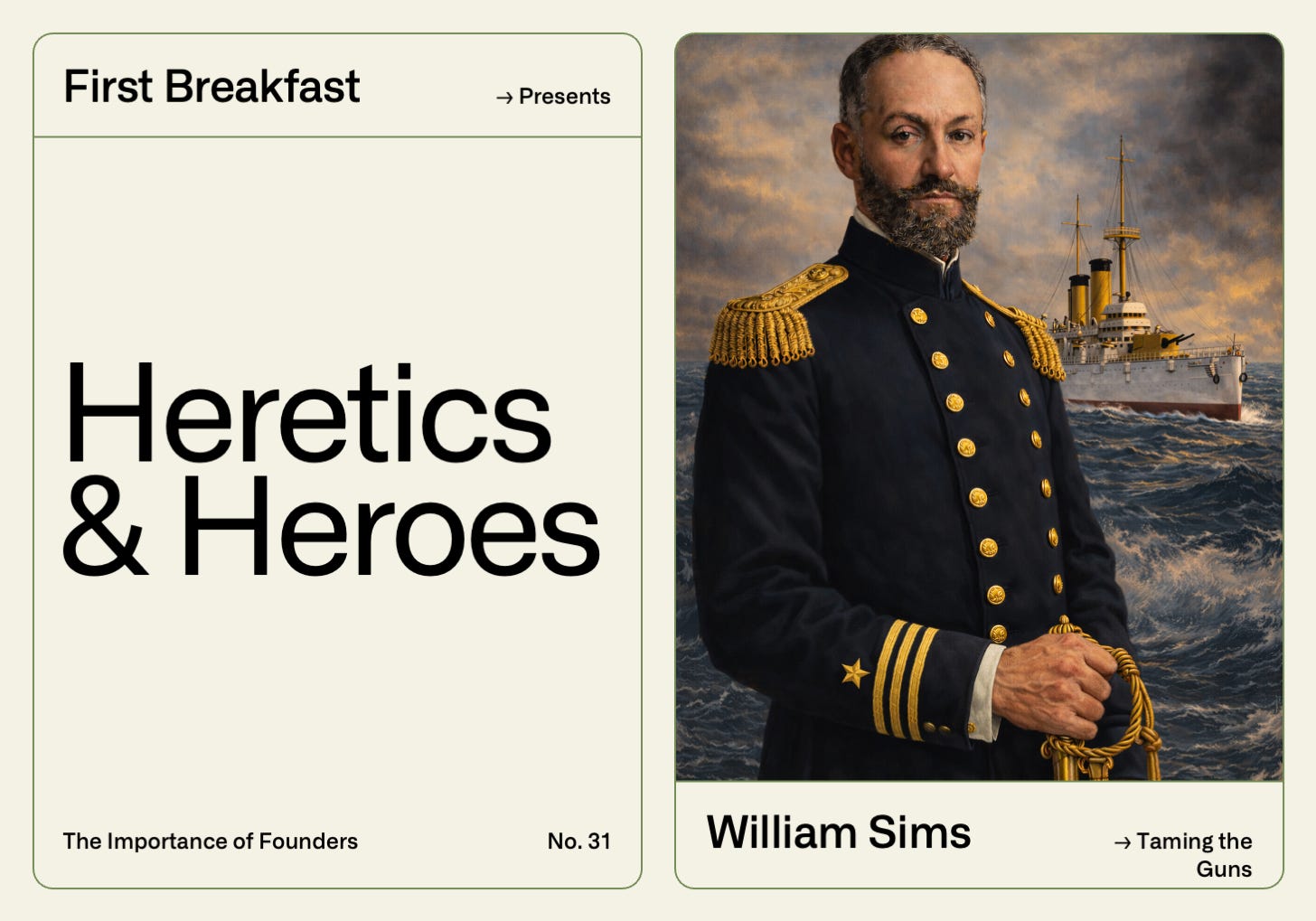
Lieutenant William Sims did not deny the charge. He justified it as a necessary act. He wrote to the president because the United States Navy could not shoot.
That conclusion sat awkwardly beside the country’s recent naval performance. The Spanish-American War had ended swiftly and decisively. But a closer inspection found that the accuracy of American guns hovered around four percent. One after-action observer remarked dryly that “Spain exerted all her skill to lose the war.”
The State of Gunnery
For centuries, naval gunfire had been a battle between gravity and swell. A gun crew stood on a rolling deck, waiting for the fleeting second when ship and target aligned. Fire too early and the shell flew high; too late and it sank into blue water. Gunnery was patience masquerading as precision.
In October 1900, then-Captain Scott of H.M.S. Terrible ended the masquerade. By re-gearing gun elevation mechanisms to allow continuous micro-adjustment, he freed the gunner from waiting for the sea’s permission. Add telescopic sights and extended range, and the effect was transformative: accuracy multiplied, rate of fire surged. The outcome was continuous-aim firing.
Despite these dramatic results, the Admiralty demurred. Scott’s comprehensive and technical report, endorsed by Admiral Edward Seymour and supported by Captain John Jellicoe, received no official Admiralty response. It was allegedly turned down by a junior lieutenant at the gunnery school. The innovation was judged against the cost of redesigning gunnery quarters and retraining all gunners across the Royal Navy.
Across the Hong Kong harbor aboard the USS Monterey, Lieutenant Sims immediately grasped the implications. What set Sims apart wasn’t brilliance or technical acumen, but a perspective that saw technology not as a threat to tradition but as a tool for mission.
The Brilliance of Lieutenant Sims
Sims was a middle-of-the-class graduate of the Naval Academy. He struggled with the entrance examinations and, allegedly, the congressman who wrote his recommendation later claimed he almost regretted doing so. After graduating in 1880, Sims spent 17 years at sea aboard numerous ships. During that time, he was shaped by the bureaucracy around him. It was an education in naval custom rather than innovation.
In 1897, his perspective widened. Posted as a naval attaché to Paris, St. Petersburg, and Madrid, Sims officially collected intelligence on the Spanish Navy. Unofficially, he learned a sobering lesson in how far the U.S. Navy lagged Europe’s great powers.
Those powers were not idle. An industrial arms race was underway: armor shifted from iron to KC steel and effective naval gun ranges expanded from roughly 2,000 yards in the 1880s to nearly 10,000 by the mid-1890s. Accuracy mattered more, not less.
Sims saw in Scott’s continuous-aim firing not a curiosity but a naval necessity. The inconvenience of redesigning ships and retraining crews paled beside a more fundamental truth: a battleship exists to hit what it fires at. Lethality is not ornamental.
Sims installed Scott’s system in his own squadron on the China Station. He took steps to retrain his gun crews and test and measure results. Their accuracy improved markedly. He reported his findings to the Bureau of Ordnance and received no response. His appeal could have ended there, alongside Scott’s. Instead, he appealed to higher authority.
Sims’s letter to President Roosevelt came through desperation. “I have within the past few months submitted to the Navy Department a number of reports on foreign target practice,” he pled. The reports concluded “that our marksmanship is so crushingly inferior to inevitably suffer humiliating defeat at the hands of an equal number of an enemy’s vessels of the same class and displacement.”
Sims had seen the future of long-range naval engagements that would characterize the Great War and sought to give the U.S. a head start. He wrote of how he had modified his own fleet but also highlighted the appalling accuracy of U.S. Navy gunnery. Roosevelt, formerly the Assistant Secretary of the Navy, understood immediately. Sims demonstrated that American ships obtained less than 10 percent accuracy, whereas Scott’s ship, H.M.S. Terrible, achieved 80 to 85 percent.
Roosevelt recalled Sims to Washington and made him Inspector of Target Practice, a position created to prove his claims weren’t fiction.
The outcomes followed swiftly. Sims implemented continuous-aim firing alongside a reformed training regime. Modeled off the Royal Navy, he launched an annual gunnery competition. The winning crews’ methods were written up and circulated across the Navy. Within years, the system increased American accuracy by 100 percent and battery effectiveness by 500 percent. An early American report suggested he had elbowed his technology into frame: “The very first practice under his system convinced the authorities that he was right and that much of the gun gear was all wrong.”
In 1909, Roosevelt summarized the progress of American gunnery and attributed the feat to Sims: “our fighting power is at least five times greater than it was before our training had been improved by Commander Sims’ methods.”
The Iconoclast
The historical record only ever suggests so much about a man’s character. What picture we do get of Sims suggests a career that never settled. In 1918, he wrote to a friend that he had “never liked” the Navy and had “never been comfortable in uniform.” There is a certain breed of officer who loves his service enough to irritate it.
Following the Great War, Sims irritated it some more. He publicly refused his Distinguished Service Medal and rebuked the Secretary of the Navy, Josephus Daniels, for altering promotion standards in ways that made them less meritocratic. His low opinion of Daniels prompted him to write a scathing report, “Certain Naval Lessons of the Great War,” which questioned the Navy’s failure to adequately prepare for war, citing inadequate ship construction among other deficiencies. Some scholars suggest that his parochial pursuit of truth is the reason why he was not promoted from Rear Admiral to Admiral.
Sims spoke truth to subordinates and superiors alike, memorably stating to 400 naval officers:
“It is not only the privilege but the duty of Army and Navy officers to direct letters of constructive criticism to their superior officers, and the officer who chooses to accept personal comfort in place of responsibility for such criticism is not only not worth his pay, but he is not worth the powder to blow himself to hell.”
Sims fought two wars throughout his career: one against foreign navies, another against the peacetime inertia and bureaucratic resistance of his own. The latter proved more exhausting.
This meant overturning assumptions and preconceptions as technology evolved. In 1921, he warned the Naval Academy graduating class against institutional calcification around emerging technology. A year later, after observing a demonstration of aerial bombing tests on naval vessels, Sims pronounced decisively: “the battleship is dead.” The man “who taught the navy how to shoot” had already seen the next generation of carrier-based warfare and wasn’t going to wait.
Continuous-aim firing did not shape naval warfare simply by existing. It shaped conflict because someone refused to let it be ignored. There are great innovators like Admiral Percy Scott who engineer innovative technologies. But an innovative technology is nothing if it languishes in obscurity. We must equally esteem iconoclasts like Sims who refuse to let bureaucracy bury the future.
Every generation confronts its own version of the four percent accuracy problem. Sims’s remedy was clear: focus on the outcome and champion the technology through the institutional machinery.
And write the letter anyway.
