


Evan Loomis, Jordan Blashek, and Morgan Hitzig are General Partners at Overmatch Ventures.
When founders and national security officials gathered in Washington last week for the Hill and Valley Forum, they shared a common premise: America is in a technology race it cannot afford to lose. They are right. What remains unsettled is how to win it.
The scale of the challenge is worth stating plainly. In 2007, the United States led China in 61 of 64 critical technologies for economic and military power, according to an analysis by the Australian Strategic Policy Institute.
Today, China leads in 57.
For three decades, Beijing has executed a coordinated national strategy to dominate the industries that will define the next century: semiconductors, artificial intelligence, autonomous systems, nuclear energy, quantum computing, and rare earth processing. While Washington debated and Silicon Valley chased the social web, China built a vertically integrated industrial base that is now outpacing America in the sectors that matter most.
The United States still fields the world’s most powerful military. But military power is downstream of technological power. And we are now running from behind.
Defense strategists have a word for how countries respond when a rival pulls ahead in capabilities. They call it an “offset” strategy: a way to gain an asymmetric edge rather than matching an adversary strength for strength.
America has done it before. After World War II, the Soviet Union held vast superiority in troops and equipment across Europe. Rather than match Moscow soldier for soldier, tank for tank, President Eisenhower turned to America’s nuclear arsenal, raising the cost of any conventional attack to an unacceptable level. When the Soviets built their own stockpile, the U.S. offset again in the 1970s by pioneering precision-guided munitions they couldn’t match.
The competition with China is different. Not in its structure, but in its substrate. Great power rivalry is not new. What is new is the degree to which technology has become load-bearing in that competition. The Cold War was primarily an ideological, economic, and military fight, with technology as an important enabler. Wars we fight today may well be determined by technology, and the pace at which the underlying stack is evolving is unprecedented. What’s more, the technologies that matter today are too tightly coupled to focus on winning just one. Quantum computing requires advanced semiconductors. Those chips increasingly rely on AI to design them. AI demands far more cheap, reliable energy than the U.S. currently produces.
Technologies no longer enable competition. They are the competition, and they are compounding faster than any single offset strategy can track. That’s why the next offset strategy must look different.
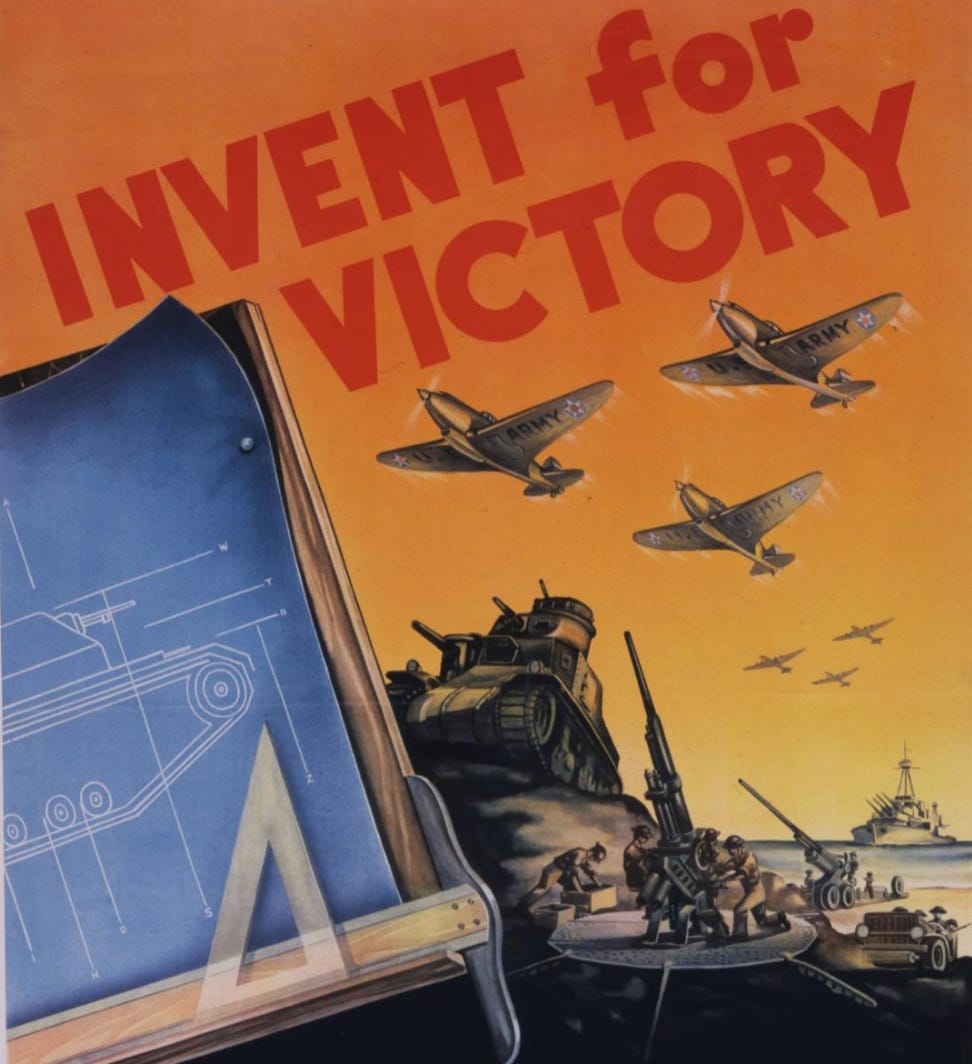
Founders — not technologies — are the answer. A single bet on a single breakthrough won’t suffice. We must place thousands of bets across thousands of founders, unleashing America’s entrepreneurial ecosystem across every critical frontier simultaneously—energy, AI, space, defense, biotech, advanced manufacturing. Founders are the only organizational unit capable of keeping pace with the rate of technological change. Institutions optimize for known problems. Founders are structurally built for unknown ones. Let the best of them surprise us with solutions central planners could never predict.
Call it the Founders Offset.
America does not need to out-China China. It needs to be more American, not less.
China’s model has real strengths. When the Party decides a sector matters, it can mobilize capital, talent, and political attention at a scale few democracies can match. But state-directed innovation has a ceiling. When the government floods a technology area with resources and mandates outcomes, the result is often what China’s own economists call “involution”—an ever-rising effort producing fewer real gains. You can build a thousand battery factories. You cannot command a breakthrough.
America’s system is architected for exactly the opposite. It is decentralized by design, driven by initiative, and purpose-built for the kind of distributed, high-velocity experimentation that the Founders Offset demands.
Consider our capital markets. In 2024, venture capital investment in the United States totaled roughly $210 billion, compared to approximately $35 billion in China. Even more important though is the incentive structure. In China, founders and investors operate under the constant possibility of state interference driven by political versus profit-maximizing motives. Even if China grew its venture capital by 6x to match ours, China’s model would still disincentivize risk-taking, dissuading founders from pursuing the hardest challenges.
In the United States, a founder who swings and misses can raise again. There is, in fact, a premium for second-time founders, even ones that did not have great outcomes the first time. This is one reason why the U.S. has nearly four times as many unicorns as China. Not because American founders are smarter, but because the American system rewards the kind of asymmetric, long-horizon risk-taking that produces genuinely novel breakthroughs.
Those individual incentives for each founder and investor compound into something larger. At its best, the American system creates a flywheel across government, capital, and industry that no adversary can replicate. Government agencies like DARPA fund breakthrough research. Founders turn that research into technology. Venture capital scales it. Industry and government deploy it. The public markets buy it, which then funds the next generation of breakthroughs.
You can see it already in companies like Saronic Technologies, which is redefining naval autonomy, CHAOS Industries, which is revolutionizing sensors, shooters, and the kill chain, and Impulse Space, which is building the propulsion systems that will define how humanity operates beyond Earth’s orbit. That flywheel is turning again today. The question is how fast America chooses to spin it.
Every generation faces a moment when the stakes of building—or not building—become impossible to ignore.
The next generation of world-changing companies in AI, energy, communications, biotech, and advanced manufacturing will either be built in the United States or selected by the Chinese Communist Party. If tomorrow’s critical technology is innovated, designed, and made in China, we will be living in a very different kind of world—and not one that Americans would accept.
So what can we do?
Policymakers should start with these three things:
1) Expand the loan program offices at the Department of Energy, Department of War, and Small Business Administration to finance the industrial buildout at scale.
2) Remove the regulatory and policy barriers that prevent national labs from partnering with startups and industry.
3) Accelerate the acquisition reform efforts already underway, giving insurgent companies clear short-term pathways to programs of record.
Investors can get creative about how America finances its industrial revival, combining every tool in their financial arsenal, from venture to project finance and the public markets, to accelerate progress and pathways to scale for this new generation of companies.
Scientists and engineers sitting inside universities and national labs can ask a harder question: is publishing research the highest-leverage thing I can do, or is building something new?
And founders—the ones who already feel the pull of a problem they cannot ignore—should pursue those quests that can tip the balance in America’s favor. The resources are there. The markets are real. And if successful, they will not only create generational businesses, they will create generational impact as well.
America never wins by planning its way to victory. It wins by unleashing people who refuse to accept the gap between what exists and what is possible, and then building until that gap closes. The Founders Offset is not a government program or a policy agenda. It is a belief that the most powerful force in the global technology race is the American entrepreneur who decides that this is their problem to solve.
The next offset will be recognized—years from now—as the moment a generation of founders decided that America’s problems were their problems. We believe that moment is now.


