

The Patriots who gathered outside Boston to fight the British in 1775 were a motley crew, high in spirit but hardly an army at all. They had no standard flag, uniforms, equipment, or arms. No military discipline. They had barely enough powder to fire their weapons, much less to dislodge the Redcoats.
The situation was enough to drive as stoic a figure as General Washington to despair. As David McCullough recounts in 1776, when Washington first heard of the dire shortage of powder, he was so stunned he did not speak for half an hour.
Little wonder the British force under General Howe, with perfect military organization and the full firepower of the Royal Navy at their backs, dismissed their enemy as “the country people,” the “rabble in arms,” and even the “peasantry.” If past peasant revolts were a guide, this would be a brief campaign. The Patriot “army” would not survive its first winter.
Perhaps those predictions would have come true, if not for the timely arrival of 58 cannons and mortars in January 1776, which allowed the Patriots to seize the high ground around Boston and send the British packing.
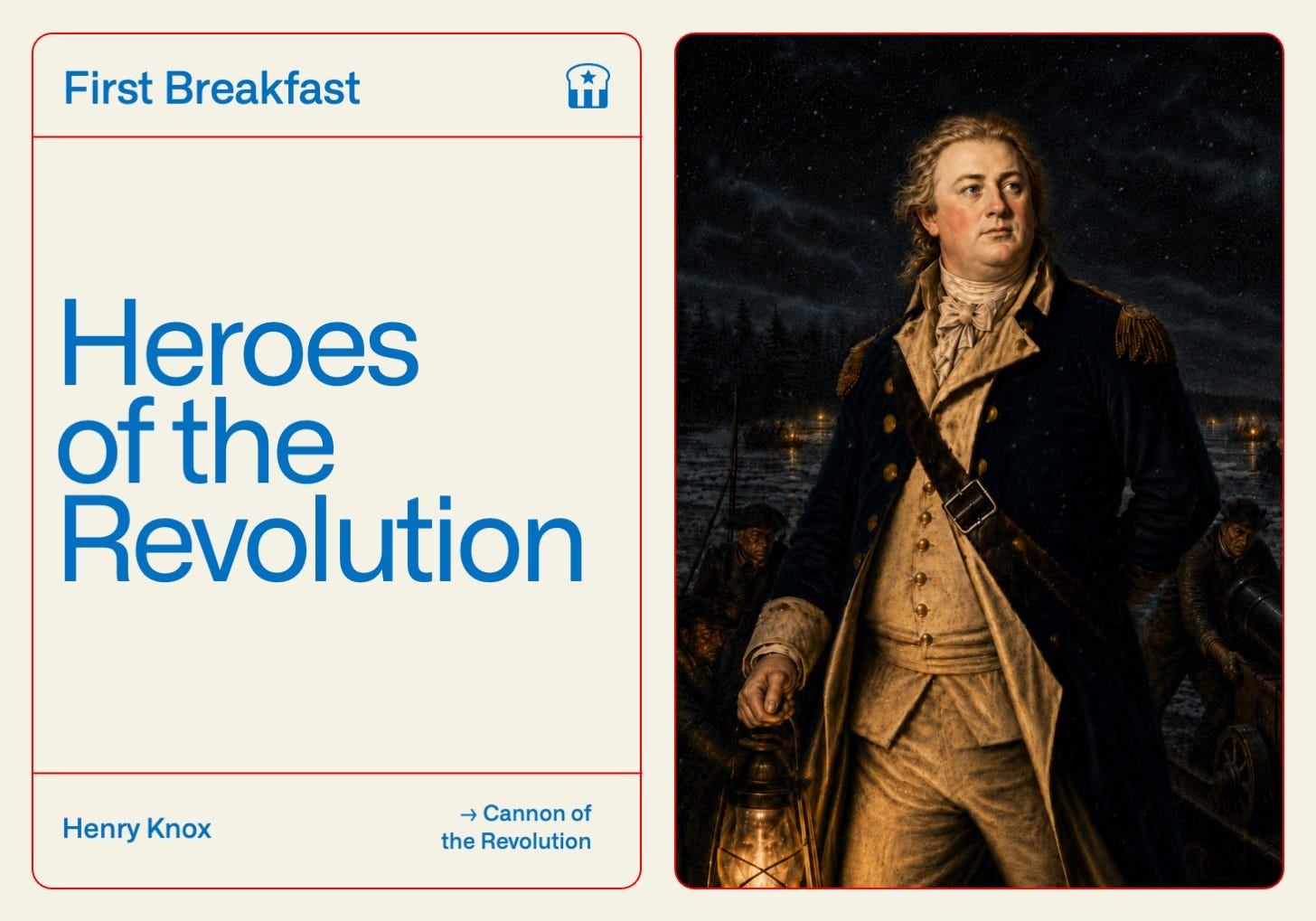
That logistical feat was the work of a 25-year-old Boston bookseller named Henry Knox, Washington’s “indispensable man,” to quote his biographer Mark Puls, as well as the nation’s first secretary of war. More than any other man save Washington, it was Knox who bound together the Continental Army like one of the volumes in his shop. He did it through careful study, unceasing action, and boundless curiosity about the technology and training that a smaller, poorer force needed to take on a superpower.
250 years later, America’s military and defense industry are downstream of Knox and the institutions he built. As America relearns how to make the weapons we need to defend ourselves, we should learn from the man who did it first.
The Boston Bookseller
Henry Knox had a hard-knock upbringing. Abandoned by his father in 1759, the nine-year-old Henry withdrew from school and went to work to support his family. His mother wisely found him work at a bookshop so that Henry could continue his education on the job and meet the educated people who frequented such shops.
Henry took full advantage of the opportunity in his teenage years, reading anything he could get his hands on about politics and his burgeoning interest, military science. He also taught himself French under the then-widespread belief that the colonies would eventually rehash the French and Indian War. His language skills would eventually help him communicate with the French as allies instead of as enemies.
Knox knew the value of education but he was not the owlish type. Physically imposing and boisterous, he was a natural leader and man of action. He took an interest in the town’s affairs and joined a local artillery company, where he learned to drill and operate cannons. The militia, known as Paddock’s Train, was run by a local chairmaker, which must have planted in Henry’s mind the idea that citizens could make fine soldiers. Later, Henry used the proceeds from his own bookstore to co-found his own artillery company, which made him known to British authorities as a capable—possibly, a dangerous—man.
They were right to worry because Knox’s sympathies were with the Patriots. His bookstore stocked Patriot pamphlets (including pseudonymous works by a young college student named Alexander Hamilton). He was present at the Boston Massacre, where he tried to prevent the confrontation from escalating to violence. He later joined the Sons of Liberty and supported its boycotts of British goods, even though as a seller of mostly British books—his store was called Knox’s London Bookstore—it meant loss of business.
Knox had skin in the game in more ways than one. His wife Lucy was the daughter of a well-to-do Tory. Disturbed by her marriage to a merchant and Patriot, the concerned father tried to buy Henry’s loyalty with a commission in the army. Sticking to his guns, Henry declined.
When news of Lexington and Concord jolted Boston, British authorities forbade Henry and other men with military skills from leaving the city. He and Lucy fled in disguise, leaving behind their possessions, family, and hopes for a normal life. Lucy in particular paid a heavy price for her bravery. She was estranged from her family, who moved to England and never spoke to her again.
The future must have seemed forlorn when Henry arrived at the camp of liberty outside Boston. Ramshackle, stinking from open latrines, and disorganized, it was an unlikely setting for the Glorious Cause. The camp had desperate need for fortifications and other works but not a single engineer worthy of the name. Henry’s knowledge of military science, from book learning and service in the militia, was invaluable in an army with little practical experience. He immediately went to work fortifying the camp. He did so for free as a civilian, volunteering his services until the Continental Congress approved his commission many months later.
General Washington identified the young Mr. Knox as a rare talent and in the fall of 1775 promised him command of the Continental Army’s artillery. The command was more theoretical than real. As Puls writes, “[w]hen Washington informed Henry that he was to take over the army’s artillery, Knox teasingly asked where the artillery was. Washington admitted that there was almost none to speak of.”
Henry would have to bring the bang himself.
Knox’s ‘Noble Train’
An opportunity presented itself almost immediately. In May 1775, the Green Mountain Boys under the command of Ethan Allen and Benedict Arnold captured Fort Ticonderoga on the border of New York and Vermont. The Continental Congress helpfully decreed that the fort’s cannons should be sent to General Washington. The only question was how.
Knox, then still a civilian in his twenties, volunteered to lead the expedition. Many in Washington’s inner circle doubted it could be done and worried about a blow to morale if the venture failed, but Washington decided to gamble. Given the state of the army, he had little to lose.
It was undoubtedly a perilous undertaking. Three hundred miles of muddy roads, rivers, and mountain separated Boston from Fort Ticonderoga. Moving 60 tons of artillery along this route—some weighing as much as 5,000 pounds apiece—would require brute strength, force of will, and impeccable timing. With winter setting in, the success of the voyage hinged, first, on getting the cannons across Lake George before it froze and, second, on sledding the cannons across frozen ground and rivers once on land. Knox’s “noble train of artillery,” as he called it, would come by water and then by ice.
The expedition took three months and was beset by temperamental weather and other obstacles. The roughly 40-mile journey down Lake George took eight days of hard rowing, breaking ice along the way. Then a “cruel thaw” delayed the overland convoy of 42 sleds and 80 yoke of oxen. Eventually a blizzard descended, allowing the sleds to move but only in the most bitter conditions. The expedition crossed the frozen Hudson River (losing a cannon through the ice, which took a full day to retrieve), see-sawed through the snowy Berkshires, and finally arrived in the Patriot camp in late January. Washington’s—and Knox’s—gamble had paid off.
The expedition had strategic consequences insofar as it enabled the Continental Army to occupy the Dorchester Heights overlooking Boston. While Knox’s new cannons bombarded the city, thousands of workmen snuck onto the heights in dead of night to erect fortifications, dig trenches, prepare obstacles, and place cannons. When dawn broke, the British were astonished to find a rebel fortress overlooking the city. Their position untenable, they were forced to evacuate the city by sea shortly thereafter. Knox’s cannons won the Siege of Boston in an almost bloodless victory, buoying the Continental Army at a time when it might have disintegrated.
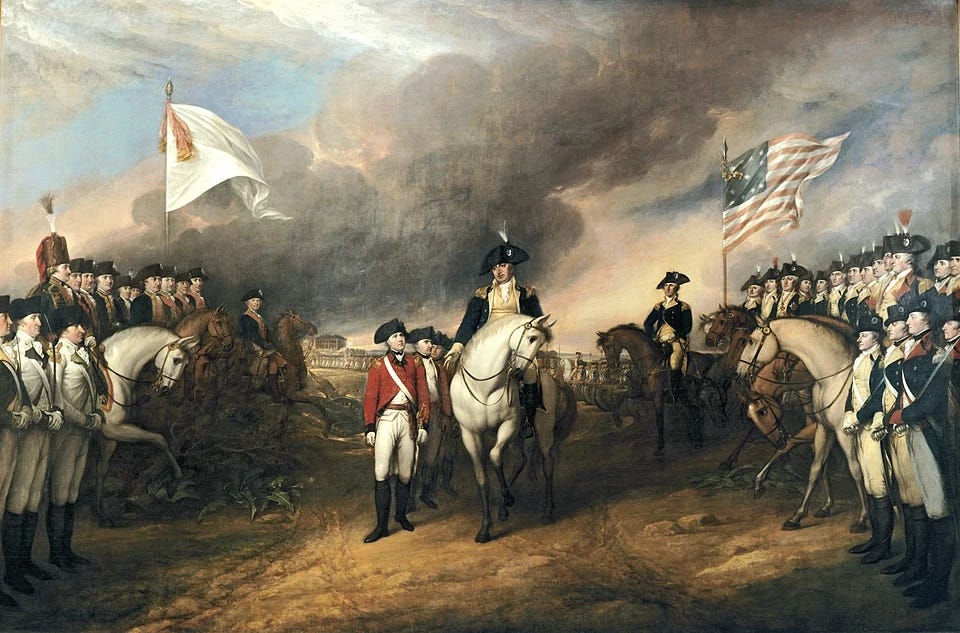
The three-month quest taught Knox a great deal about military logistics and artillery that he put to good use for the rest of the war. The Continental Army’s legendary crossing of the Delaware on Christmas 1776 was orchestrated by Knox, the master of perilous river crossings. He oversaw the movement of an incredible 350 tons of artillery, men, horses, and supplies on shallow-draft boats whose crews he had recruited. First-hand accounts of the crossing recall the confusion and darkness of the night, punctuated by Knox’s booming voice directing the traffic. He later crossed in the same boat as Washington. By the Siege of Yorktown five years later, Knox’s artillerymen and engineers were as professional a force as any in Europe, drawing praise from normally superior French officers. Knox’s cannons, often aimed by his hand, laid down a punishing fire at Yorktown that made resistance impossible and hastened Cornwallis’s surrender.
So vital was Knox to the American victory that Washington recommended his promotion to major general after Yorktown in defiance of a seniority system that said he had not reached the minimum age. Congress agreed, granting the promotion “on account of his special merit and particularly for his good conduct at the siege of Yorktown.” Knox was 31 years old.
An Army Worthy of a Free People
Knox’s achievements as an artillery commander are more than enough to qualify him as an American hero. The institutions he built during and after the war vault him into an even higher strata. America’s defense industrial base, professional military education system, and armed forces bear his fingerprints. Knox was not only a warrior but a builder.
The guns of Ticonderoga, like many of the arms the Patriots used, were cast by the French. Knox was only too happy to use foreign arms in a pinch, but he knew America needed the means to produce such weapons itself. If America could not make its own arms, the Patriot cause would be at the mercy of others. “Let us for a moment suppose a misfortune happen to the field Artillery we have in this army,” Knox mused to John Adams in August 1776. “Where shall we get immediately supplied—not in America.”
To address this problem, in December 1776 Knox penned “A Plan for the Establishment of a Corps of Continental Artillery, Magazines, [and] Laboratories.” The plan called for the creation of a defense ecosystem that could produce artillery, small arms, and munitions and train a cadre of skilled American craftsmen. The first priority, he wrote, was to build and mount 150 cannons. It was an audacious proposal at a time when the Continental Army was in headlong retreat and Congress was evacuating Philadelphia in expectation of a British invasion (around that time, Washington wrote to his brother that “the game is pretty near up”).
Yet Knox’s plan was prescient. The next year, after the crisis passed, Washington entrusted Knox with selecting the sites for American arsenals. One of the sites Knox selected was Springfield, Massachusetts, ideally situated on the Connecticut River as a source of power and means of transportation. Knox was intimately involved in the technical details of the site’s construction, stipulating the types of furnaces, mills, and other works that were needed, authorizing the recruitment of skilled laborers, and securing supplies of copper and tin for cannons. The Springfield Armory would produce weapons for the American military well into the Vietnam era. The surrounding Connecticut River Valley was America’s first true industrial cluster, pioneering mass production using interchangeable parts. It is little exaggeration to say that Knox’s sound judgement in wartime laid the foundation for America’s industrial boom in the nineteenth century.
Weapons factories were one thing, but Knox knew the American cause also needed factories for men. Like Washington, Knox was generally unimpressed by the quality of American officers. “There is a radical evil in our army—the lack of officers,” he wrote in 1776. “We ought to have men of merit in the most extensive and unlimited sense of the word.” Not everyone could be an autodidact like Knox, so the solution was an academy modeled on the European tradition that could teach promising Americans the science of war. “Military academies must be instituted at any expense,” Knox wrote to Adams. “We are fighting against a people well acquainted with the theory and practice of war—brave by discipline and habit furnish’d with every implement of war necessary for any enterprise. What do we oppose to these?”
In 1778, while the army wintered in Pluckemin, New Jersey, Knox founded such an academy. Again it was an unusual priority, as the Continental Army faced critical shortfalls of virtually every kind of supply, including food. Yet Knox knew training could not wait. The academy he built was at the center of camp and its tallest building. Knox developed the curriculum and was essentially the sole instructor, leading live demonstrations of the weapons in the Continental arsenal. He also used the academy to create a feedback loop between the factory and the frontline. As Puls writes, “[d]uring lulls of activity in the war front, artillery officers would be sent to the military laboratories to learn more about munitions manufacturing and gain knowledge that might be helpful in the field.”
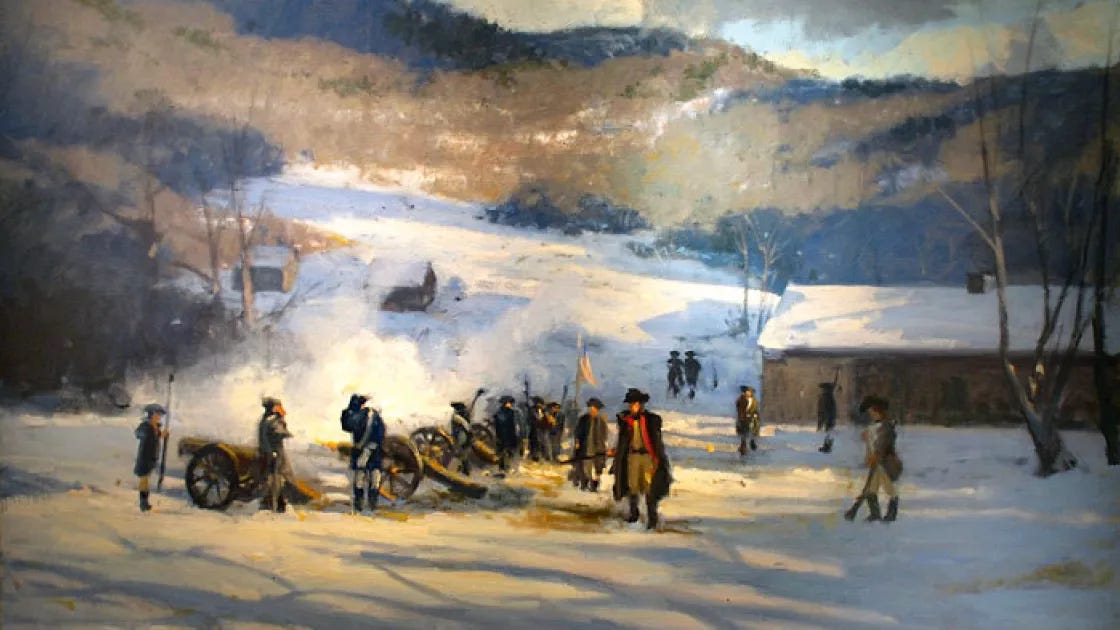
The Pluckemin school was the first military academy in the Americas and a direct predecessor of the U.S. Military Academy at West Point—another Knox brainchild. In the immediate aftermath of the Revolution, Knox submitted a brief to Washington on the military institutions the new republic needed to defend itself. He identified the fort at West Point as the “key to America” and argued for co-locating a military academy with the existing arsenal. The students at the academy would get an education in theory and action, just as Knox had gotten in his youth. “All the scholars should be obliged to study the science of artillery and engineering,” he wrote. And they should learn by observing and mingling with the “artificers,” or factory workers, who operated the “manufactor[ies]” of small arms and cannons on site. In his final years, Knox had the satisfaction of learning that President Thomas Jefferson authorized the opening of a military academy at West Point along these lines.
When the Peace of Paris concluded in 1783, Major General Knox desired nothing more than to leave the military behind and reunite with Lucy and his children. Like Washington, however, his fellow citizens soon called him back to service. Briefly floated as Washington’s vice president, Knox accepted a more familiar post as America’s first secretary of war, where he prepared America’s military for a new challenge: preserving the Constitution and America’s independence.
Many Americans were skeptical of a standing army, viewing it as a threat to liberty from long and painful memory. Knox, who had smelled the powder and blood of the Boston Massacre, sympathized with their concern. But he knew a modern army was the only way Americans could remain free. The solution was to build a new kind of government and military that was worthy of a republic and, as he put it, “compatible with the interests of a free people.”
The brief he wrote to Washington in 1783 explains what was required to build such a military. First, the American people themselves would have to be trained and prepared to fight. “The people universally should be furnished with arms and know how to use them,” he wrote. The states should raise strong militias. And the national army should be capable and led by well-trained men of character, which required conscious efforts to “make the profession of arms honorable.”
The key to Knox’s vision for a republican army, from Pluckemin to West Point to the Office of the Secretary of War, was its emphasis on people. America needed strong institutions to create the leaders it needed to remain free; it needed strong leaders to steward those institutions and help America remain free.
Books and Battle
Henry Knox is not as well-known today as he deserves. He lacked the ambition and self-promoting tendency of equally brilliant men like Hamilton and Jefferson. His finances were always perilous and shoring them up preoccupied his later years. He also suffered repeated personal tragedies. Only three of his 13 children with Lucy survived to adulthood, shrinking what should have been an illustrious line. His surviving son, Henry Jackson Knox, ended up in a debtors prison.
Forgotten for too long, this year is the perfect time to burnish Knox’s legacy and reflect on the lessons of his life.
Knox reminds us that theoretical and practical knowledge go hand in hand. A young Henry learned to be a military engineer in Boston bookstores and bloody battlefields. Without the former, he would not have been useful on the latter—or at least, he would have faced a much steeper learning curve.
Knox also shows once again the primacy of people. He was an exceptional talent, used to his full potential by Washington. He multiplied his legacy by creating institutions to train future exceptional talents.
Our Armed Forces, our defense industry, and our freedom are downstream of Henry Knox: America’s first defense technologist.