

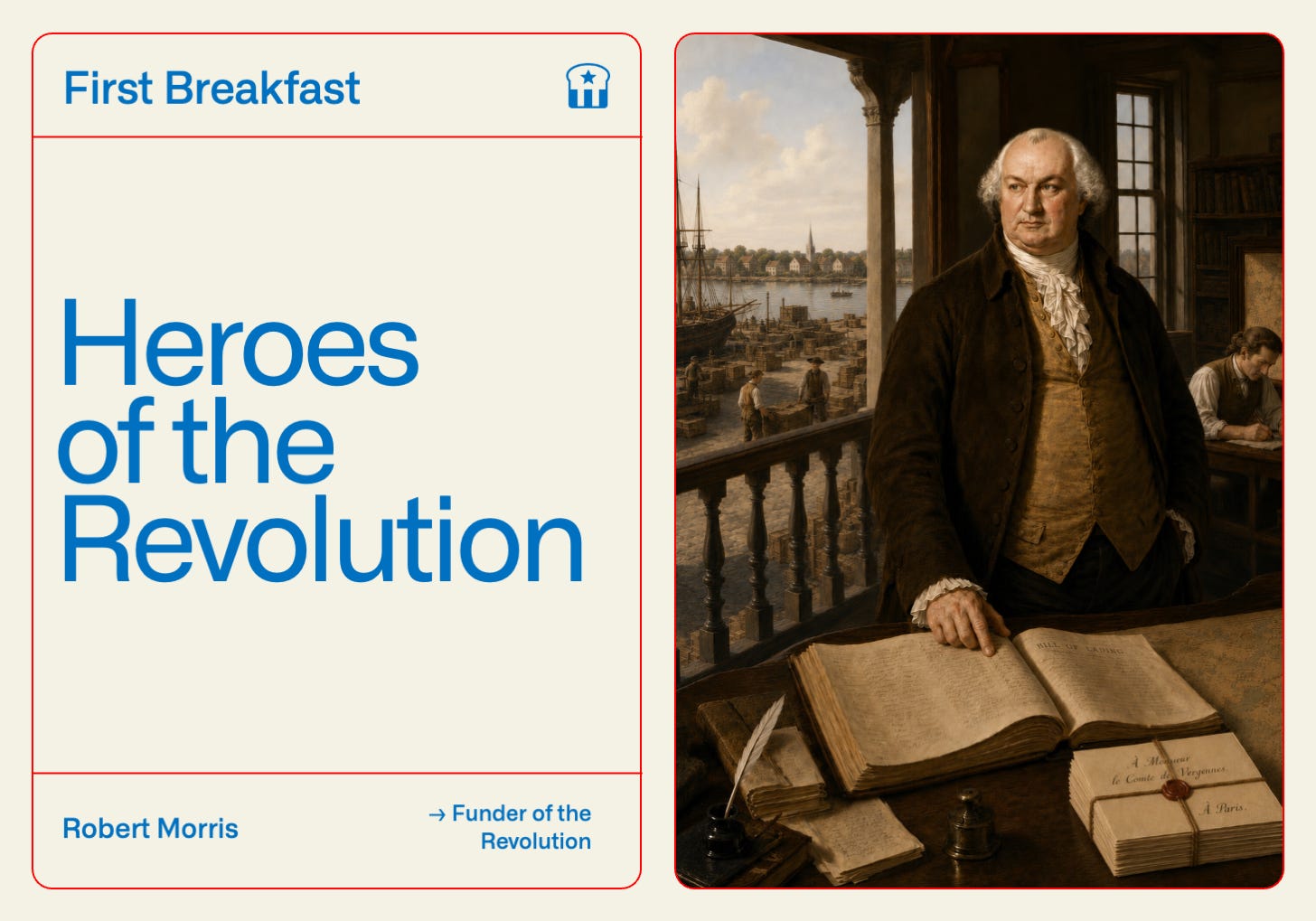
“My dear general, I can never do things in the small. I must be either a man or a mouse,” wrote Robert Morris in a 1793 letter to his friend and president, George Washington. The words were written amidst a land speculation bet that led to Morris’s financial and reputational ruin and consigned him to the margins of history. Yet it was the very audaciousness of this lesser-known Founding Father that would prove indispensable, time and again, to the fledgling republic.
Morris financed and supplied the Continental Army, famously extending his personal credit to do so. He created a privatized procurement system and advocated for fiscal responsibility in repaying the national debt at a time when both measures were unpopular. He was a free-market capitalist who believed financial policy should “be founded in the nature of man; not on ideal notions of excellence.” And he was one of only two men to sign the Declaration of Independence, the Articles of Confederation, and the Constitution (Roger Sherman of Connecticut was the other).
But first and foremost, Morris was a merchant. He was born not in the Colonies but in Liverpool in 1734. When Morris turned 13, he joined his father in Maryland. The senior Morris was a tobacco trader and soon sent his son away to Philadelphia to learn the trade. While he inherited a decent sum of money on his father’s death a few years later, the younger Morris was fast becoming a successful entrepreneur in his own right. At 21, he founded Willing & Morris with Thomas Willing, the young heir of the trading house where they both worked.
Morris’s biographer Charles Rappleye described Morris’s rise as “an unprecedented ascent for an outsider at a time when family connections were largely determinative.” Willing & Morris established itself as one of the most influential trading houses in the Colonies. Morris recounted how he dispatched a staggering “50 to 60 sail of stout ships” during the winter of 1774. He was eager to trade as much flour and wheat with the British Empire before hostilities forbade it. The aggressive trade expedition illustrates Morris’s opportunistic nature—a nature that would later be weaponized against him as evidence of corruption and avarice.
Morris was neither a zealot for independence nor a naive loyalist. He was an early opponent of the Stamp Act in 1765, yet he urged reconciliation with Britain for over a decade later. When Parliament enacted the Intolerable Acts in response to the Boston Tea Party, Morris understood the stakes had changed, even if he believed reconciliation was still possible. In 1774, he wrote “Poor America. This is the beginning of troubles, but its [sic] better to die bravely than be starved by pickpockets.” He would apply the full force of his abilities to the rebel cause.
Tell Me, Muse, of the Man of Many Jobs
The most proximate problem was how to arm the Continental Army. Washington’s gunpowder shortage was severe. At one point, the general resorted to mixing sawdust with powder. In response, in 1775 the Second Continental Congress formed the Secret Committee of Trade to secure arms and ammunition.
Morris’s status as the foremost colonial merchant was fundamental to overcoming the challenges facing the 13 colonies. The would-be nation was without a navy, a currency, a bank, or formal diplomatic channels. A successful merchant served as a sort of privatized expression of these functions.
Morris soon led the Secret Committee. The moderate Pennsylvania delegate operated a networks of spies, established clandestine supply lines in Europe and the West Indies, and administered contracts, often using false cargo registers and sailing orders to avoid detection. It was dangerous work—the sea swallowed ships as often as the Royal Navy did. Morris nonetheless secured the principal source of powder and saltpeter for the Continental Army. He may have been the most reluctant signer of the Declaration of Independence, but Congress could not have asked for a more creative and enthusiastic arms smuggler.
The Secret Committee of Trade was only the beginning. Within months he led the Marine Committee (charged with standing up the Continental Navy) and the Secret Committee of Correspondence (in essence, a nascent State Department). The country’s first warship was none other than Willing & Morris’s Black Prince. It was fitted out as a 24-gun frigate and renamed the Alfred. Morris supervised the construction of ships and commanded naval operations. These actions were complementary to the primary mission of the Correspondence Committee, namely, establishing diplomatic ties with potential European allies. He supplied diplomats with speedy packet boats to survive the contested passage littered with British cruisers.
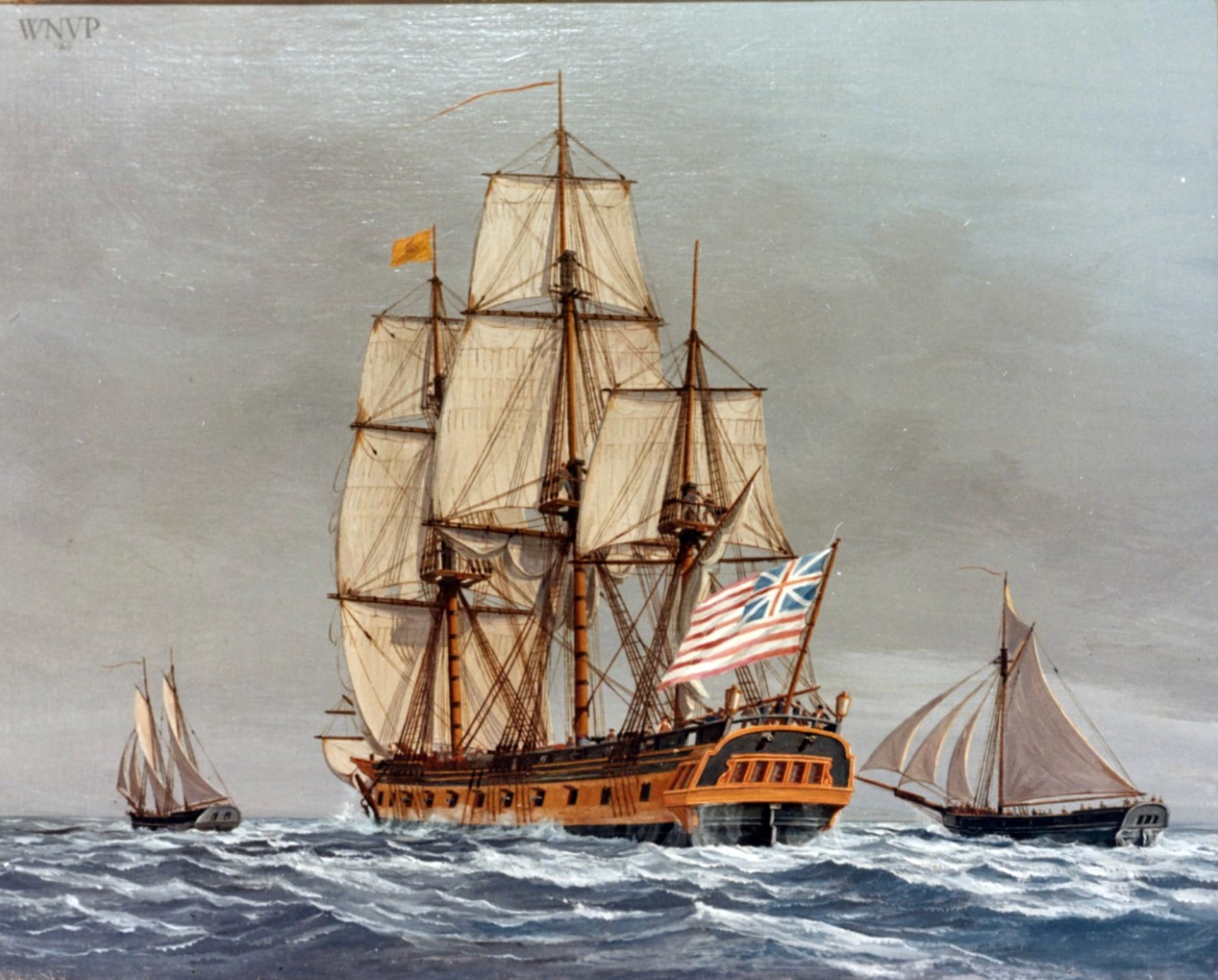
Thus was Morris instrumental in opening up the critical supply lines with France. In September 1776, Morris, along with Secret Committee colleague Benjamin Franklin, learned that France would covertly supply America with major shipments of arms. The two determined “It is unnecessary to inform the Congress of this intelligence at present, because Mr. Morris belongs to all the committees that can be properly employed in receiving and importing the expected supplies.” Morris’s centrality to affairs could not be plainer.
Yet his resume continued to expand. In December 1776, as General William Howe’s troops prepared for a push into Pennsylvania, the delegates of the Continental Congress fled Philadelphia for Baltimore. Morris was one of three delegates to remain, where he operated under the express orders to “execute Continental business.” His modest responsibilities included running the Navy solo. Rappleye writes, “At this crucial juncture, he was essentially serving as chief executive of a beleaguered government facing its most severe trial.” Morris had an indefatigable work ethic and was not prone to self-pity. Still, a letter to John Jay conveys the intensity of the work: “The business of this committee engrosses my whole time & increases daily. I am now the veriest slave you ever saw.”
Morris would soon be lending more than just his time to the republic.
Monopoly Money
In a wartime economy, a country’s financial system is redirected toward financing a war. During World War II, the U.S. government issued war bonds to raise money while minimizing inflation. Such a redirection is, of course, contingent upon a country having a public financial system. Revolutionary America’s wartime economy was often just Robert Morris personally bankrolling the new nation.
Under the Articles of Confederation, the government lacked the ability to levy taxes. It could “requisition” (i.e. nicely ask) the states for revenue, but—unsurprisingly—the states often found they had little money to volunteer. Without guaranteed revenue, the government could not establish creditworthiness. It resorted to huge printing runs of the new national currency. Before long, the phrase “not worth a continental” was as commonplace as the refusal to accept the currency as a means of exchange.
And that is how the nation came to rely on so precarious a backstop as one highly levered merchant.
Throughout the war, Morris purchased all manner of supplies using his own credit. Hard currency was in such short supply that Morris lent Congress the entirety of his personal reserves. The icy winter of 1776 would have been even colder if not for Morris. He financed the purchase and directed the transportation of thousands of blankets and wool stockings that arrived in time for Washington to stage his attack on Trenton.
Nearly five years later, as Washington prepared for a long march south from New York to the Chesapeake, the absence of a functional paper currency threatened the entire campaign. Morris made the bold move of printing and circulating a new paper issue. These “Morris notes” were nominally associated with the government but were in fact backed by Morris’s personal credit; if Congress failed to provide funds, Morris himself was on the hook. Generals Washington and Rochambeau had provisions for Yorktown because of Morris. An otherwise reserved History of Government Contracting is effusive in its praise: “Without his financial connections, attention to detail, and superb administrative talents—and issue of over one million dollars of personal credit—the outcome of the battle, and possibly even the war itself, might have been different.”
In 1781 the Continental Congress unanimously elected Morris to be the Superintendent of Finance. It was one of four newly created executive departments. While the title brings to mind our modern Secretary of the Treasury, the position was functionally the chief executive of the government. George Washington was arguably the only individual more powerful than Morris.
One of Morris’s enduring contributions as Superintendent—both to the country and specifically our modern defense industry—was his implementation of a private contracting system. For most of the war, the procurement of supplies was an entirely public function. Commissaries bought, stored, and distributed goods to the Army. The incentive structure was deeply flawed. Agents were paid commissions as a percentage of what they spent, and fraud was rampant. States, meanwhile, were expected to supply the government with whatever they could spare via a a barter-like system known as “specific supplies.” When states managed to pony up beef or flour, the food often spoiled for lack of funds to transport it.
Morris considered the whole system “almost useless to the government.” He was forced to implore the states for supplies, warning that those who failed in their duties “will have to answer for it to their Country, to their Allies, to the present Generation, and to all posterity.” He detested making these moral appeals. Morris was a markets-oriented merchant who believed in the power of financial incentives.
The private contracting system he implemented appears straightforward today, but it was a dramatic departure for the time. Morris issued calls for supplies, and businesses responded with sealed bids. Contracts were awarded to the lowest bidder who could also provide the most generous payment terms to the impoverished government.
The system wasn’t perfect. There were reports of collusion among contractors and tainted goods. But Morris’s system was unquestionably more effective and cheaper than the commisary system, and it crucially did not depend on anything so fickle as the altruism of man. In 1783, Washington wrote, “I have...the satisfaction of seeing the troops better covered, better clothed, and better fed than they have ever been in any former Winter Quarters.” By dispensing with the romanticism of a voluntary call to arms, Morris was liberated to define a capitalist relationship between government and industry that persists today.
No Conflict, No Interest
Morris was an easy target for his enemies. Throughout his public service, he remained active in private business. His trading house Willing & Morris at times received half of all contract dollars that flowed through his committees. Other contracts for supplies frequently went to merchants in his network. A 1779 Congressional investigation accused Morris of using public office to enrich himself and award preferential contracts to his friends while leading the Secret Committee. He was never found guilty of wrongdoing, but the accusations stuck and contributed to his unjust legacy as America’s first war profiteer.
The Congressional investigation was ironic in light of the covert affairs Morris was leading. All actions of the Secret Committee were treason against the Crown. Morris could not exactly publicize a gunpowder smuggling contract in fair and open competition. It’s clear that Morris was valuable to the Revolution precisely because of his network of suppliers, international relationships, access to credit, and physical assets at his command. Further, some of the enmity directed toward Morris was more ideological than personal. Virginia delegate Richard Henry Lee, for instance, simply had an objection to capitalism, remarking “The spirit of commerce is the spirit of avarice.”
The negative attitudes toward businessmen leveraging their private networks in service of the war would foreshadow later criticisms of the “dollar-a-year men” during World War II. Wartime production czar William Knudsen was maligned for his connections to the automotive industry. But to limit wartime mobilization jobs to those without industry experience would be to limit the jobs to those who were definitionally unqualified. At no time was this more true than the American Revolution, when there was no federal infrastructure to mobilize.
The end of Morris’s tenure as the Superintendent of Finance was prolonged and painful. His March 1783 letter of resignation declared, “I never will be the Minister of Injustice.” Morris had grown too frustrated with Congress’s indifference to paying its debts and creating a creditworthy nation. It took him almost two years to extricate himself from the role because a fresh crisis had occurred: the soldiers hadn’t been paid in months and were threatening mutiny.
Their destitution was, in fact, an issue that had plagued Morris and Washington throughout the entire war. Now as Washington prepared to disband the army, he despaired over sending his men home “like a set of beggars.” Morris would be the nation’s piggy bank one last time. He issued notes redeemable in six months and backed by his personal credit. He then personally signed six thousand notes. In all, he issued some $1 million to feed and pay the troops. These were onerous financial obligations that exposed Morris to serious personal risk.
It was a mostly thankless job. Those who accused Morris of getting rich were perfectly happy to watch him overextend himself. Morris was not after plaudits, but he cared about his reputation. To defend his integrity, Morris published a 200-page Statement of Accounts shortly after leaving office. “The master should know what the servant has done,” began the report addressed to his “Fellow Citizens.” What followed were detailed actuarial tables and financial statements—from Morris’s public and private dealings—of revenues, expenses, and loans from his time in office. He printed 500 copies and distributed them to Congress.
Despite the rocky resignation, Morris was not finished with public service. He remained influential in Pennsylvania politics and was a natural choice to be one of the state’s inaugural senators. President Washington then approached Morris to be the nation’s first secretary of the treasury. Morris declined the role but astutely recommended Alexander Hamilton for the job.
In another example of Morris’s mangled legacy, his influence on the nation’s financial future is all but erased. Hamilton’s financial plan of 1790 was directly inspired by Morris’s ardent campaigns as superintendent of finance. The federal government would assume the states’ debt and fully fund the national debt. Creditors would be paid in full, restoring the public credit of the new government. And the whole funding scheme would be possible because there was finally a revenue foundation via national taxation.
Hamilton succeeded where Morris had failed because he had what Morris never did: the Constitution’s taxing power. Morris brought a knife to the fight, while Hamilton got to bring a gun.
Maybe someone should make a musical about Morris.
Icarus
Morris was an entrepreneur and a workhorse. After exiting public life, he relished the opportunity to dedicate the next chapter of his career fully to the private sector and create an empire. He used credit to buy up millions of acres of land in New York, Pennsylvania, and the District of Columbia. Morris’s big bet was that land prices would rise, European and American buyers would appear quickly, and credit would remain loose.
Those assumptions didn’t hold. Notes were issued against future land sales that did not materialize, and lawsuits, weak demand, and a tightening credit market put the squeeze on Morris. When it became clear he was headed towards financial ruin, he he did what gamblers do and doubled down. It didn’t help that his business partner and Pennsylvania comptroller, John Nicholson, was corrupt in ways Morris never was.
Morris and Nicholson had over $12 million in combined debt by 1796. Morris was arrested and spent three and a half years in a debtor’s jail in Philadelphia. His freedom was salvaged by the enactment of a personal bankruptcy law in 1801, but his finances and reputation were beyond recovery. He quietly spent the rest of his life with his steadfast wife Mary, the mother of his seven children. They subsisted on a small stipend from Morris’s longtime friend and fellow Founding Father, Gouverneur Morris (no relation). Robert Morris died in 1806.
Morris was a man of contradictions. He was skeptical of independence from Britain but worked doggedly to achieve that goal once it was set. He mastered the intricacies of monetary policy but was also comfortable chumming it with sailors on his ship decks. And he created the blueprint for America to pay her debts, only to die crushed by his.
Yet there is no contradiction where it mattered most: Morris consistently chose the republic over himself.
Further Reading
Robert Morris: Financier of the American Revolution by Charles Rappleye (2010)
A History of Government Contracting, Second Edition by James F. Nagle (1999)