

BRYAN CLARK is a senior fellow and director of the Center for Defense Concepts and Technology at Hudson Institute.
The congressional elections earlier this month should be a wake-up call for those who claim the U.S. military’s problems can be cured with more money. This argument was always wrong, but it kept money flowing from Congress to the defense industry and then into campaign coffers and think tank budgets. Now the Pentagon needs a plan to compete and win without a blank check from Capitol Hill.
The Navy is most in need of fresh ideas. Seven months into the war against Iran, two aircraft carriers, three amphibious warships, and fifteen destroyers remain in the region to protect shipping through the Strait of Hormuz and enforce a blockade of Iran’s ports. That is more than a third of the Navy’s deployed ships at sea. The Navy can maintain that presence indefinitely, but only by cutting time for training and maintenance or sending fewer ships everywhere else.
With gas prices coming down and fewer attacks on Gulf allies, the Trump administration is in no rush to end the conflict. U.S. warships could end up guarding Iran and the Strait of Hormuz on a near-permanent basis. Like the Army and Marine Corps during the previous decade’s Middle East wars, the Navy could find itself increasingly consumed in an overseas mission that is largely forgotten at home.
The Navy cannot grow itself out of what will likely become a death spiral of declining retention, material condition, and readiness. As part of our recent fleet design study for the U.S. Navy, the Hudson Institute found that today’s fleet is half the size of its Reagan-era predecessor but costs the same to operate, crew, and maintain. During the last decade, the Navy retired more ships than it built not due to a lack of shipbuilding money but because people, parts, and petroleum became more expensive.
The Navy is awash in shipbuilding dollars today, which is bolstering the bottom line of shipbuilders with more than $100 billion in backlogged orders. But the Navy won’t get the hundreds of billions of dollars to sustain and crew those ships when they hit the fleet in five or 10 years. Navy leaders will have to follow their predecessors and retire ships early to free up sailors and funding for the new ones.
A design problem misdiagnosed as a money problem
There is a way out of this strategic cul-de-sac, and it doesn’t involve more money.
The Navy needs to deploy two dozen ships to the Middle East because every one of them is a manned, multimission vessel. The Navy cannot afford to lose one to hostile fire, so during combat it deploys ships in groups that can overcome an opponent. All of those ships need support from refueling and resupply vessels, which are likely to come from outside the combat zone. And those logistics ships need to be protected.
All of this protection and support adds up. In wartime, every naval deployment becomes a big one as evidenced by the chart below, which summarizes the last 80 years of U.S. Navy surface fleet deployments as a time series.
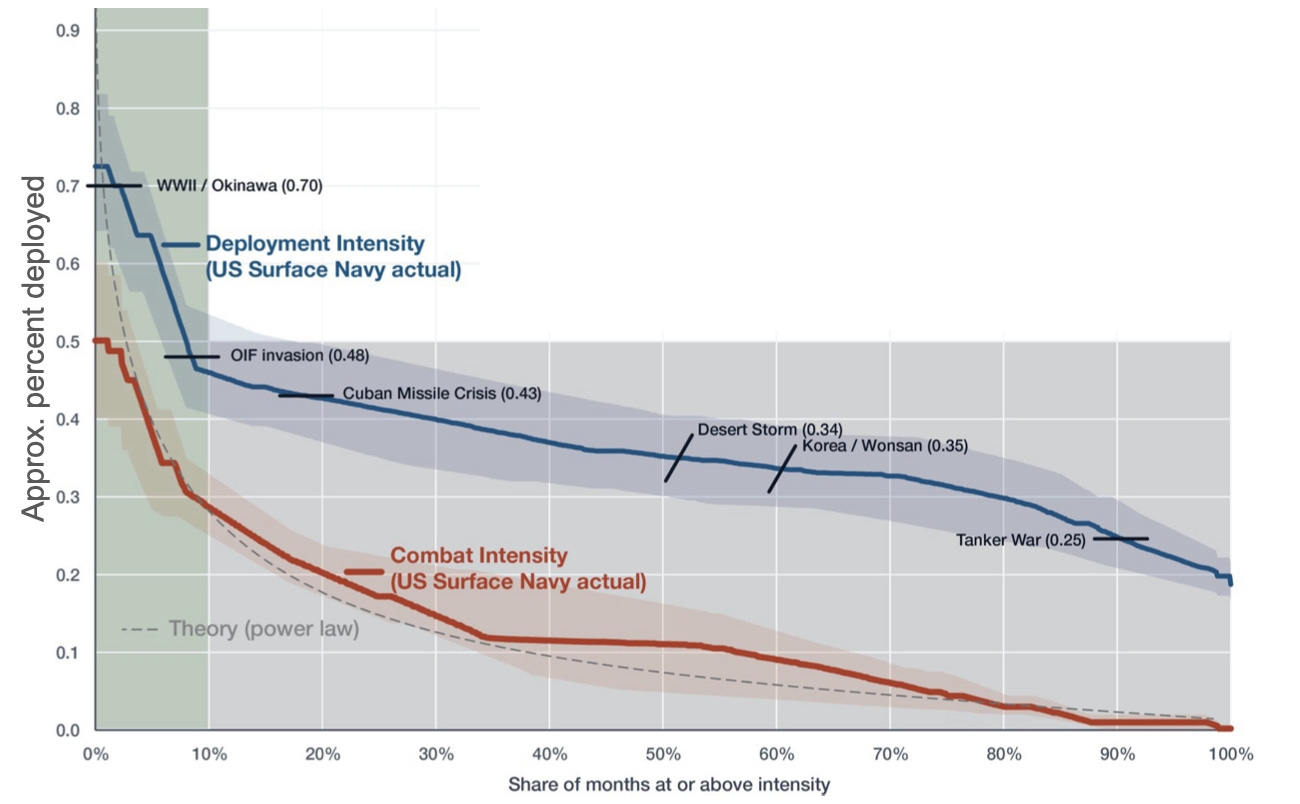
About one-fifth of the surface fleet is always deployed, as shown on the right side of the chart. Moving to the left the percentage deployed rises for lesser fractions of time, corresponding to periods of crisis and conflict. At 10 to 15 percent, the curve turns rapidly upward, reflecting the need for mutual defense and protected logistics in wartime environments like during the Cuban Missile Crisis or World War II.
The Navy’s problem today is this curve is becoming steeper. As the Houthis and now Iran show, almost any adversary can exploit digital technology, commercial products, and modern manufacturing to produce long-range precision weapons at scale. Until recently, the Navy could surge forces or mobilize the industrial base to support the 10 to 15 percent of situations that demanded large force deployments. Now the curve gets steep for at least 20 percent of operations, a trend that is exacerbated by the shrinking fleet.
This will only get worse. America’s opponents will benefit from continued advancements in commercial technology, including artificial intelligence. And the cost to crew, maintain, and operate the fleet keeps rising.
The Navy needs a new fleet design that flattens the curve.
One way to lower the need for escalating deployments is by using more unmanned systems. Because they are more expendable than a manned ship, the Navy can deploy unmanned vessels and vehicles in smaller numbers that lack the overmatch of manned carrier or surface groups.
Another way to flatten the curve is by forward-basing these unmanned systems. They can refuel and rearm in port without risking manned oilers and cargo vessels during underway replenishment missions. And their operators and maintainers ashore can use nondescript commercial facilities that would be too small or generalized to support manned combatant ships.
Critics will point out several shortcomings in this design approach. The most fundamental is that forward-based unmanned systems cannot address the wide range of potential crises and missions that might emerge. To be expendable and scalable, unmanned systems need to have only one or two main functions and are generally either slower or have less endurance than their manned counterparts. And by being forward based, they are tied to a region and cannot easily redeploy.
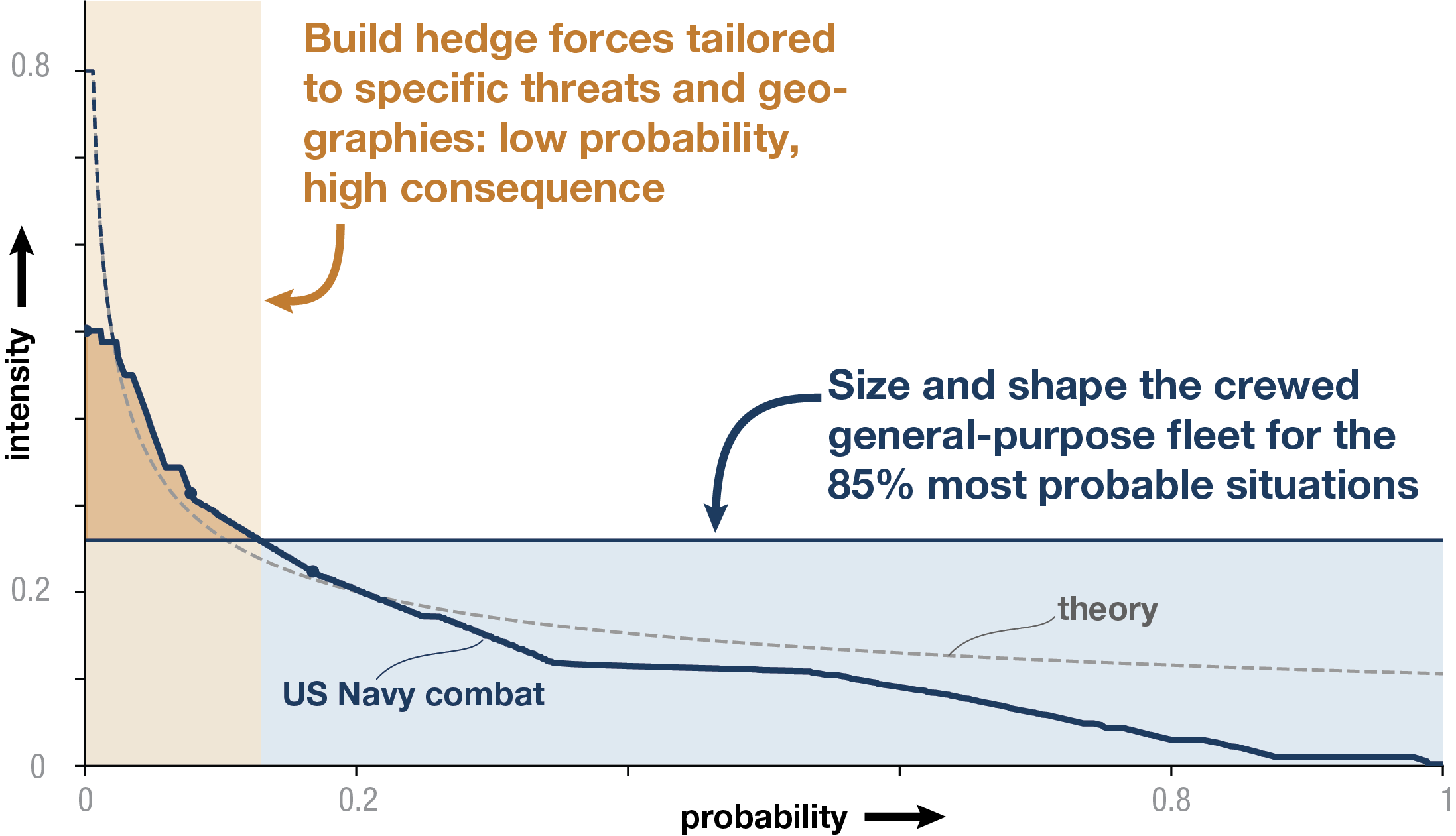
The Navy could exploit, rather than mitigate, these limitations by fielding unmanned systems as part of tailored forces that hedge against specific scenarios the fleet would not be able to address at acceptable risk. Arguably, the current blockade of Iran and defense of Persian Gulf shipping fall into that category. These high-risk scenarios tend to lie on the left-hand side of the demand curve above.
The figure below overlays a new force design paradigm on the demand curve. During periods of relative peace on the right side, the Navy can rely on a manned general-purpose fleet that it can afford to crew, operate, and maintain. For scenarios and geographies where the fleet will fall short on the left side, the Navy could deploy hedge forces comprised mostly of unmanned systems. These scenarios can be defined with sufficient precision that the Navy could tailor a forward based force to address them.
During our last three years of modeling and simulation and more than a dozen wargames with the U.S., Australian, and Japanese navies, we found about a half-dozen scenarios that were beyond the capability and capacity of the fleet America can afford to keep. Two of these scenarios were mine clearing in the Strait of Hormuz and protecting shipping in the Red Sea from drone and missile attack.
Win the adaptation competition
The Navy could use medium unmanned surface vessels to host counter-drone systems and missile launchers to shoot down Iranian and Houthi air attacks. Smaller unmanned surface vehicles can guard against one-way attack drone boats. And both could help destroyers herd Iranian ships attempting to break the blockade.
But the biggest benefit of shifting to unmanned systems for missions like these is their adaptability. Iranian and Houthi technicians have been refining their weapons and building new ones despite being under fire from U.S. forces. The Navy has scrambled to counter these new threats by reprogramming complex combat systems like Aegis.
With their modular designs and software-defined behaviors, unmanned systems are easier to update and modify than highly-integrated manned ships or aircraft. This is one reason why Russian and Ukrainian forces continue to rely on drones for nearly all their attacks. As described in our historical study of military revolutions, the side that adapts fastest wins when everyone in a conflict has access to the same technologies.
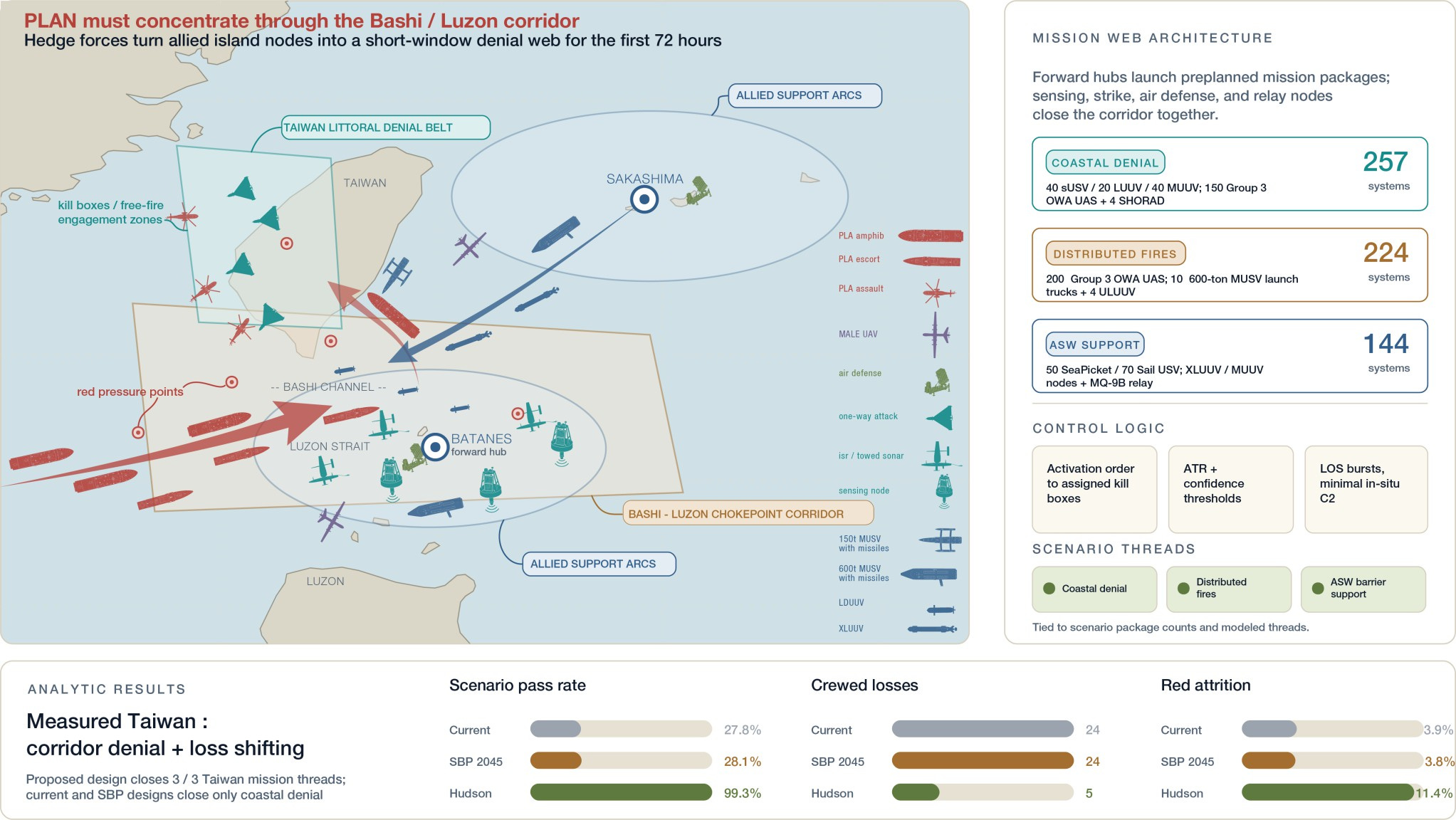
The challenge of defending Taiwan provides a great example of how hedge forces can enable the Navy to keep opponents off balance. The U.S. Pacific Command’s “Hellscape” concept would protect Taiwan’s northwest coast using one-way attack drones on, above, and below the water. This approach allowed Ukraine to cut off Russian access through the Black Sea.
Recognizing the threat posed by the Hellscape, China’s People Liberation Army is already developing countermeasures. In response, the U.S. Navy could field a new set of unmanned systems in a hedge force that cuts off Chinese access through the Bashi Channel south of Taiwan. As shown in the figure below, this hedge force could stop a Chinese invasion against Taiwan from the south and prevent the PLA Navy from encircling Taiwan during a blockade.
Ukraine’s experience against Russia demonstrates that the Navy will need to make industry a co-equal partner in fielding and evolving hedge forces like those shown above. The Navy cannot update its unmanned systems on the weekly or faster tempo that is the norm in Ukraine if an acquisition office needs to issue a task order and sign off on every adjustment. Operators and industry technicians will need to collaborate in the field to either stay ahead of the enemy—or give them a new dilemma.
This approach acknowledges that the locus of military technology development has shifted from government to industry. Commercial R&D investment outstrips government research spending by orders of magnitude, placing many military technologists in the position of being fast followers.
The Pentagon may have given us the internet and GPS, but today it’s just another customer for AI models, satellite communications, and drones from private companies. This levels the playing field for America’s adversaries, as with Iran. But the Navy can exploit the commercialization by fielding hedge forces of unmanned systems that can ride the wave of changing technology to win the adaptation competition.
Scale, then scale again
Adaptation is more than developing a new widget or vehicle behavior. The Navy will need to scale each new change over a relevant part of the force. And defense companies will need to shift from producing thousands of identical weapons or vehicles to building dozens or hundreds of one system, reconfiguring, and manufacturing dozens or hundreds of the next version.
U.S. prime contractors cannot retool their production lines and software stacks for sophisticated missiles or manned ships and aircraft at Ukraine speeds. But that is not necessarily a problem. These general-purpose forces need to accommodate a wide range of potential situations and therefore need to pack a lot of functionality into relatively small packages. This necessarily constrains their modularity and ability to specialize.
But the Navy needs an element of the fleet that can adapt at Ukraine speed. Hedge forces of unmanned systems can evolve quickly thanks to their relatively small scale and modular software and hardware designs. As in the Taiwan example above, they would also form the front line against capable opponents, compelling adversaries to engage in a move-countermove competition with the U.S. military that could undermine their confidence in future plans for aggression.
But the relatively small scale of hedge forces can present a challenge for suppliers, which will need to frequently adjust system configurations or stop production of a system entirely.
Companies can still remain competitive in a market of constant adaptation. One option is to establish automated manufacturing facilities that can pivot between configurations and products as demands change. Some of these manufacturers use AI to translate new concepts into detailed designs and production processes that respond to changing operational needs.
Suppliers can also move between commercial and military customers, as US contract manufacturers have done for decades. This provides an opportunity to exploit some of America’s commercial strengths relative to China. For example, China is the world’s largest shipbuilder, but U.S. recreational boat builders produce more than twice as many ski boats, personal watercraft, and pontoon boats as their Chinese counterparts. They could manufacture hulls for hedge forces on those same lines. Similarly, the Navy could leverage America’s edge in commercial software integration and rapid software development to field new hedge force concepts and compositions faster than opponents.
The Navy is already developing hedge forces like its unmanned mine clearing units in the Persian Gulf and the Taiwan defense Hellscape. Until now, the Pentagon has treated these solutions as workarounds for unique situations. The Navy needs to establish them as a key element of its future fleet design, rather than as band-aids. It is the only path to affordably meeting future demands and exploiting America’s strengths in future wars of adaptation.
