


THOMAS DAY is the executive director of Frontier Mission Network, a business consortium dedicated to serving the Chicago region’s national security and defense technology sector. He is also a lecturer in tech-based economic development at the Harris School of Public Policy at the University of Chicago.
Last month, the White House Office of Science and Technology Policy (OSTP) released Science: A New Golden Age, a detailed roadmap for overhauling American science. It summons the legacy of Vannevar Bush’s Science: The Endless Frontier, a document issued in 1945 that laid the foundation for the American innovation engine, and argues that the model now needs to be updated.
Researchers, founders, capital investors, and regional policymakers should read and reflect on OSTP’s proposed reforms, then think about how to respond. There is much in the document that warrants serious attention and transcends partisan politics. As left-of-center blogger and economist Noah Smith puts it: “If Democrats take back the White House in 2028, they need to pick up this plan, slap a little token partisan gloss on it, maybe have Claude rewrite the language a little, and fully fund it.”
Indeed, the OSTP recommendations, if enacted, funded by Congress, and put into action locally, could revive American R&D and chart a long-term roadmap as the American economy navigates the age of AI. Rather than fight to defend the status quo, regional innovation economies should recognize that many of the OSTP’s proposed reforms are sensible and respond with collaborative action.
It Starts With Problems
In his introduction, White House Office of Science and Technology Policy Director Michael Kratsios notes that the “greatest technical achievements of the last century came about because leaders in government identified national priorities and marshaled the resources to accomplish them.” In doing so, Kratsios echoes the words of Bush in the opening chapter of Science: The Endless Frontier, similarly drawing a line connecting American science to national problems: “(W)ithout scientific progress no amount of achievement in other directions can insure our health, prosperity, and security as a nation in the modern world.”
If the federal government is going to mobilize science in response to national problems, regions should be asking how they can respond, organizing their own institutions and resources around the problems the federal government has identified. This was a point made by retired Col. Peter Newell, former director of the Army’s Rapid Equipping Force, in a podcast interview I did with him earlier this year. I asked how we could grow our organization, Frontier Mission Network, into one that actively creates value for the national security community and the broader U.S. economy.
Newell’s response: “It starts with problems.” This is the opposite of starting with a technology or an idea for a business you think might solve a problem. To create value, understand the national problems first and mobilize, he told me.
Regions can point to local research assets and to new R&D funding awards, but if the science being done in their regions is not solving national challenges, its economic and national strategic value is unlikely to be realized—and certainly will not be under the OSTP’s new framework.
Build Around Scientists With Long-Term and Flexible Funding
Vannevar Bush’s model for mission-driven science channeled federal funding through universities, enabling researchers to conduct research in place. The OSTP report argues that we need to fundamentally rethink this central role universities play in the American innovation engine.
Its criticisms of universities focus on cumbersome bureaucracies—“Universities … extract significant overhead from researchers, which funds a mix of legitimate shared infrastructure and growing administrative bloat”—and misaligned incentives. PhD candidates are at universities for relatively short periods, the OSTP report notes, undermining long-term knowledge retention. “[N]o technology company would entrust its core R&D to a workforce composed primarily of temporary trainees, yet this is the standard model in academic research.” The report also calls into question the professional incentives placed on PhD candidates and professors to publish and accumulate citations.
No doubt many inside universities will react negatively to the OSTP’s criticisms. Many others have known for some time that without fundamental reforms around citation incentives, this will be the result, put graphically:
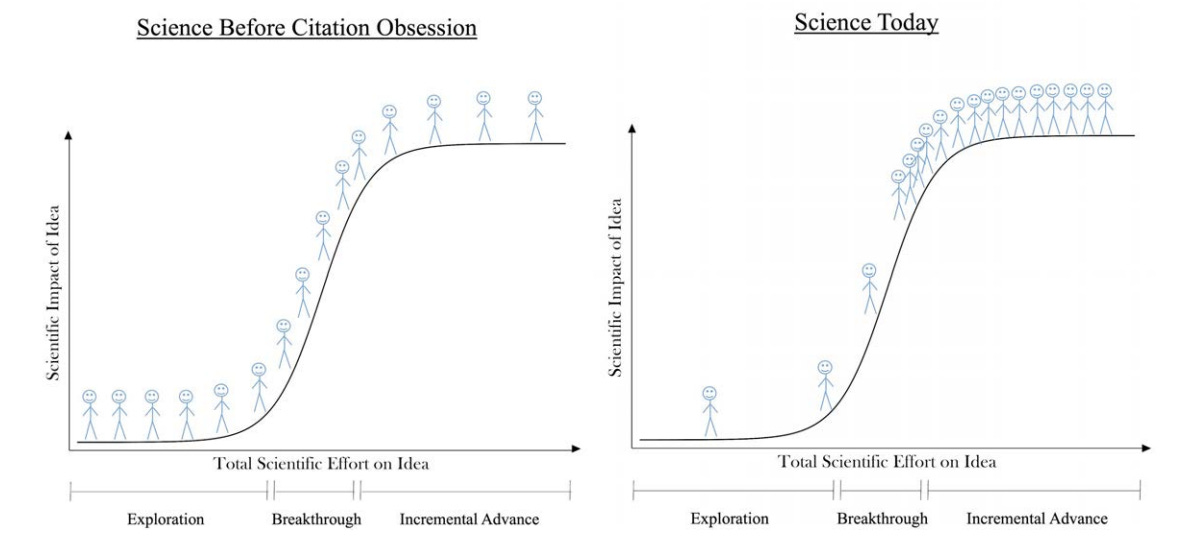
To support breakthrough science, the OSTP report calls for a fundamentally new approach to grantmaking. It advocates directing more funds directly to scientists and empowering recipients to take their awards with them if they move to a new employer—including a startup—without losing federal funding. If enacted, this reform would expand portable grant programs like the National Science Foundation’s Graduate Research Fellowship Program. “The (NSF Graduate Research) fellowship provides three years of support with full portability across institutions, freeing recipients to follow intellectual opportunity,” the report notes. “The results speak for themselves: more than forty GRFP alumni have gone on to become Nobel laureates.”
The OSTP also calls for longer-term awards, moving away from project-based awards that yield safer research proposals. “[W]hen investigators receive longer-horizon support with tolerance for early failure, they produce portfolios with both more hits and more misses, the signature of genuine exploration.”
Finally, the OSTP calls for expanding portfolio-based approaches to funding science, empowering program managers closest to technological frontiers to make bold, multi-million-dollar bets, an approach championed for decades by the Defense Advanced Research Projects Agency.
If enacted, these reforms could mark the most fundamental change in American science in 80 years—moving immeasurable amounts of power and funding away from universities and into the hands of researchers. Some will protest, but with the ranks of college administrators skyrocketing in recent years, let’s not confuse enhanced competition for talent with undermining American science. I certainly won’t be going on a hunger strike to protect privileged institutions while they revel in single-digit undergraduate admissions rates.
Regions should prepare now by proactively identifying their best scientists and thinking through how to directly engage and retain researchers rather than assuming universities will anchor them locally.
Imagining New Models for Public-Private R&D
In 1997, Intel, Motorola, and other companies, with support from the U.S. Department of Energy, formed the Extreme Ultraviolet Limited Liability Company, a consortium established to advance EUV technologies that would later accelerate advanced chip production (more on that in a bit). EUV LLC was built to solve a problem—design the next generation of tools that could make the most advanced semiconductors imaginable—and then shut down. The photolithography methods EUV LLC developed helped make the modern chip industry possible.
Perhaps the legacy of EUV LLC is as much about the public-private partnership model they pioneered as the technology it produced. To fund research into EUV lithography, private backers purchased shares of the company in exchange for the right of first refusal of what it produced.
This model is just one that OSTP report argues should be supported and replicated.
The OSTP report also calls for new nonprofit-focused research organizations, or FROs, that hire researchers within a time-bounded vehicle focused on a specific technical milestone that, if successful, would produce public intellectual property. You might think of FROs as a mini national laboratory model that could be infinitely replicated to pursue defined objectives. “The time-limited nature (of FROs) also gives scientists who complete the project a chance to return to academia, or to spin off a startup and raise venture capital,” the OSTP report notes.
Another idea: In July, the National Science Foundation announced a $47 million pilot program to jointly fund PhD students with university and industry partners. Funded Ph.D. candidates do their first few years in an academic setting and complete their final year with a tech company.
Regions should think about responding proactively by building new, mission-focused institutions that reflect the role of profit motives in advancing science. Such an approach would require departing from assumptions about who should support basic research—assumptions I, too, have long held.
For eight years, I have taught a class in regional tech-based economic development at the University of Chicago’s Harris School of Public Policy. One point I make midway through the course is that the growing share of business-funded R&D is drawing too much focus toward profit motives and away from knowledge creation, historically done at national and university laboratories.
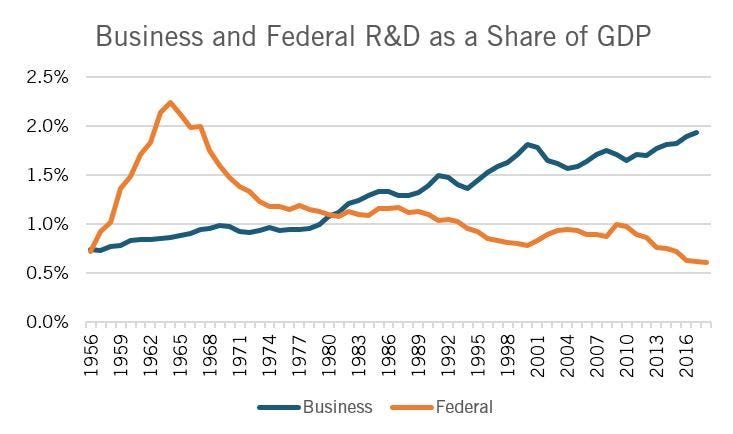
The OSTP report counters that this framework is outdated, pointing to a greater share of science acting in “Pasteur’s Quadrant,” or use-inspired basic research. It also points to the role of private capital in enabling research efforts to scale. “Venture capital mobilizes private resources toward high-impact technologies….Ph.D. students and professors can now raise hundreds of millions of dollars to found companies that pursue fundamental breakthroughs.”
Whatever the right balance of public and private R&D, it is indisputable that both forms can lead to genuine breakthroughs and innovation. To cite just two examples, the potential for nuclear fusion to generate more energy than it expends was demonstrated at Lawrence Livermore National Laboratory, while a private company (DeepMind) discovered the 3D shape of proteins.
Point is, let’s not get too ideological about the role of federal research labs and universities in supporting research. The OSTP report argues that industry consortia like EUV LLC should play a more central role in advancing basic research and the broader American innovation economy. For regions that spent much of the 2010s building coworking spaces and business incubators, the OSTP report might mark a moment where civic efforts are instead directed at building similar, mission-focused, time-bound consortia to solve national problems.
Facilitate Testing
In the 1950s, as Cold War tensions heated up, Area 51, a plot of land in Southern Nevada, served as a classified testing ground for programs like the U2 spy plane.
Around that time, entrepreneurs and hobbyists began testing rocket designs at a testing site in the Mojave Desert in California. The Mojave testing site has since expanded geometrically, and the OSTP report notes, “[m]ultiple rocket companies have emerged from this cluster of cheap leases, federal licenses, and shared test infrastructure to win NASA prizes, raise substantial venture capital, and reshape the commercial launch industry.”
Innovation needs a testing ground. “Test infrastructure, whether for rockets, advanced manufacturing, autonomous systems, or any frontier technology, is an enabling resource that determines whether the next great American company starts in a desert lot or dies on the vine in a student’s garage,” the OSTP report notes.
Dr. Jerry Hendrix, now the associate director of shipbuilding programs at the White House Office of Management and Budget, has championed the idea of an “Area 52” in his home state of Indiana along Lake Michigan for unmanned, autonomous naval systems.
Similarly, First Breakfast’s Shyam Sankar and Madeline Hart have highlighted a proposal for a network of technology proving grounds, hosted at unused federal lands and military installations. Perhaps someone in the Pentagon was reading. Earlier this month, the U.S. Army established new testing grounds for commercial technologies on federal lands in Utah, Michigan, and Mississippi.
Regional leaders should recognize technology testing as a critical element of the value-creation process and assess where technologies can be tested in their back yards.
Build Production Near Science
The next step after the scientific breakthrough is ensuring it translates to production and the broader economy.
The consortium I discussed earlier provides a cautionary tale: EUV LLC served to design cutting-edge lithography equipment that used waves of light to engrave transistors onto wafers. That breakthrough was commercialized not by an American sponsor but by ASML, a Dutch company that maintains a supply-chain chokehold on the world’s most advanced lithography equipment to this day. ASML was permitted to purchase EUV LLC’s IP rights in exchange for promises to source components from the United States—promises that were not kept or enforced.
EUV LLC is thus yet another story of American deindustrialization, where we invent but do not build breakthrough technologies. It also illustrates the need to build supplier networks that put research and production in proximity.
To capture the economic benefits of science—which is necessary so long as American taxpayers fund American science—the OSTP report argues we need to follow breakthrough science with process knowledge retention. Think of programs to allow community college students to work alongside PhDs and receive industry credentials that they can take to manufacture technologies produced by American research. This would serve not just local workforce development, but the advancement of science, the OSTP argues.
“[A]cademic publications alone remain insufficient to transmit the craft of science…Our true competitive advantage lies in the process knowledge embodied by America’s talent. Without skilled practitioners who pass their craft to those who follow, the engine stalls…Without local manufacturing capacity, the marriage of science and craft weakens. Scientists lose access to the practical problems that inspire new lines of inquiry and improve research quality, while industry loses the research ecosystem that sustains technological leadership.”
One Final Note…
I don’t agree with every word in the OSTP’s report, yet it is a critical, potentially massive step torward mobilizing the American economy to meet peer threats.
The OSTP’s critics cannot simply respond to these proposals with grievance. If you object to the report, what’s your plan? The status quo of America’s innovation base is a world where the gap between China and the United States grows smaller while the gap between San Francisco and the non-superstar cities grows larger. The trendlines are not positive. So what’s your plan?
Director Kratsios and OSTP have offered theirs. It deserves our serious attention and hopefully will spark a substantive debate.
