

OLIVIA KUZMAN is an Associate Communications Manager at Anduril. She previously managed public affairs at the National Reconnaissance Office.
In 2024, Anduril made a bold public commitment: the company, then known primarily for its command-and-control software and growing fleet of autonomous robots, would design, build, integrate, and fly its own spacecraft.
Just two years later, Anduril-216 reached orbit.
What follows is the story of how they got there, as recounted by the team that made it all happen.
Project Jan
Anduril’s work on the space problem set began on the ground, long before it had any orbital ambitions. The company had worked with the United States Space Force closely for years. Through USSF’s Space Surveillance Network, Anduril took on the modernization of some of the nation’s most critical Space Domain Awareness assets. Specifically, it was up to Anduril to integrate legacy ground systems with Lattice, the company’s core software layer, to power a resilient mesh network, reducing data latency from hours to seconds.
Still, despite its name, Anduril’s space business in 2024 was entirely terrestrial. That would soon change.
Adam Thurn, now VP and GM of Orbital Systems at Anduril, joined the space team in 2023 after four years at Terran Orbital where he oversaw engineering for NASA and Space Development Agency missions. He came in firing.
“Two weeks in at Anduril and realizing what made this company unique with being able to leverage the immense software power from Lattice, I said we need to build an on-orbit data processor to truly get after spacecraft mission autonomy,” Thurn said. And so began Project Jan.
The advantage Thurn saw was based on the company’s differentiated approach to software. For years, Anduril has been pushing data processing and networking to the tactical edge with Lattice, unlocking autonomy across domains: air, land, and sea. The natural next step for Lattice was bringing it to space. Lattice could transform satellites from passive sensors into intelligent nodes, but doing so would require significant compute hardened for an exoatmospheric environment and designed to integrate with every system onboard a spacecraft.
A team of just five people gave itself three months to design, build, and test a new and spartan prototype with no software updates, straightforward ground tasking, and third-party capabilities only where necessary. They just made the delivery cutoff for our partners at Apex, providing the spacecraft’s platform. Weeks later, the payload reached orbit for the first time.
Project Jan culminated with a linear task: taking a photo, processing it on orbit, and sending it back to the ground. But as simple as that sounds, the full end-to-end operation — successfully launching, delivering telemetry, and executing commands on orbit — represented much more. It was the foundation for more ambitious missions to come.
Payloads
Military planners have warned that access to space is no longer guaranteed for the United States or its allies. Adversaries are investing heavily in on-orbit capabilities specifically designed to counter our own. Russian assets are maneuvering dangerously close to U.S. satellites on a regular basis. China has more than tripled its annual space launch rate in the past decade, while deploying high-end capabilities like the Shenlong space plane.
For the Space Force, this means the window to establish credible deterrence is narrowing. From its inception in 2019, Space Force leaders have characterized deterrence in space in similar terms to deterrence on Earth. It starts with understanding what adversaries are doing on orbit and building the capabilities needed to counter them to maintain American space superiority.
As such, Anduril’s space business was created to deliver on the clear mandate of deterrence, bringing autonomy, awareness, and maneuverability to the fight to secure the domain.
Modular mission payloads make that execution possible. Payloads are the hardware that defines what a spacecraft can actually do — whether that’s edge processing, sensing, or something else entirely.
Onboard compute isn’t new to space. It dates back to the Apollo era of human spaceflight in the 1960s. The Apollo Guidance Computer replaced the manual control sticks used during earlier crewed missions with an onboard system that handled the guidance, navigation, and control computation needed to get crews to the Moon and back. But technological development has not kept pace with the level of on-orbit autonomy required today.
Spacecraft still lack the advanced computing and speed required to support real-time decision-making. In a domain that is more contested than ever, space professionals need imaging and processing capabilities that reduce the time between collecting information, delivering insights, and acting.
Anduril had a theory of the case on how to address this, building on projects already underway across the company. The Imaging business was already tasked with modernizing sensing capabilities in a range of form factors. Applying the same principles to space would address critical blind spots in space situational awareness. Whereas other sensors depend on illumination from the sun, long wave infrared technology could detect thermal signatures of satellites hidden in Earth’s shadow.
Hardware development was equally important. Each payload would be modular — compatible with a variety of satellite interfaces and power sources — so that any payload could connect to any bus quickly and repeatably, without the custom engineering or years-long development cycles that are commonplace in space technology.
As the space team refined the concept, it was clear that subsystems and prototypes weren’t going to be enough to fulfill these goals. A fully integrated spacecraft was necessary.
Enter Lectronimo
The massive next step the team rallied around was to put a satellite in orbit, a step change from Jan. The team had already proven that developing the subsystems to support onboard processing was technically feasible. The real challenge was to replicate their theory with a broader set of capabilities on a full spacecraft: Anduril-216, a mission internally dubbed “Lectronimo.”
This was a sizable and risky bet. Lectronimo didn’t have a customer; it was internally funded from the start. It also had an ambitious list of desired requirements:
Mission Compute Module (MCM): an edge compute processor that enables on-platform processing, fusion, and storage of data in real-time to execute autonomous operations.
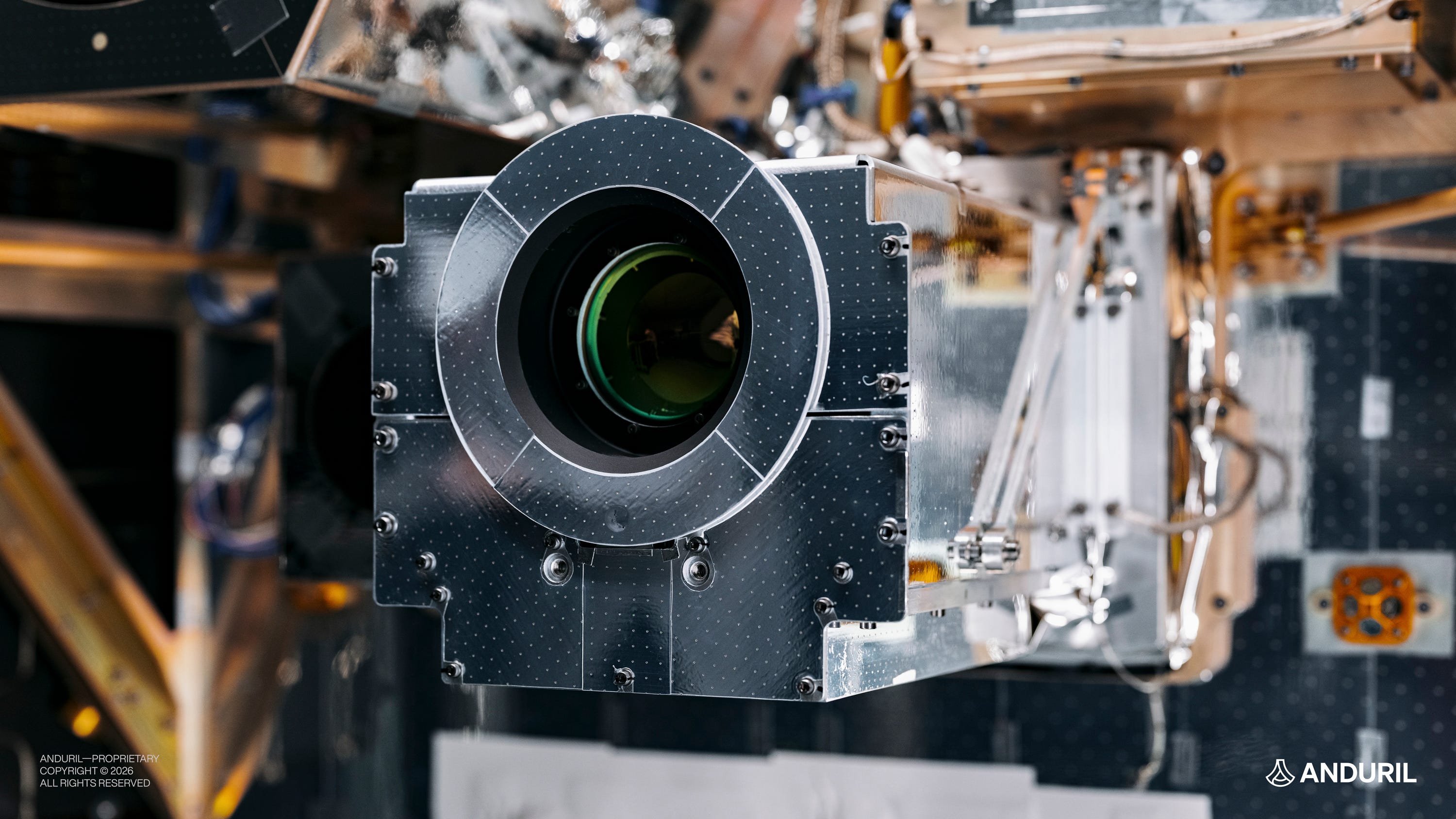
Long-Wave Infrared Space Sensor: a long wave infrared sensor that unlocks imaging capability by detecting heat signatures and other characteristics of spacecraft, even during orbital periods of eclipse.
Dynamic Payload Power Module (DPPM): a smart power management system that adapts and regulates bus power outputs to meet the disparate requirements of different mission payloads.
A project like this also couldn’t be undertaken alone. Anduril partnered with Apex again to execute this mission. The teams shared a solid foundation: during the early days of Project Jan, Apex’s Aries bus carried the first iteration of Anduril’s edge processing payload in its inaugural mission.
So it was settled. In less than two years, Anduril’s orbital systems team would design, develop, launch, and operate a satellite to validate three modular payload capabilities for Space Domain Awareness, as well as two additional third-party payloads, and establish the orbital heritage Anduril needed to carry out future national security missions.
The team was in place. The theory was established. Now, it was time to prove it could all work together.
The Early Days
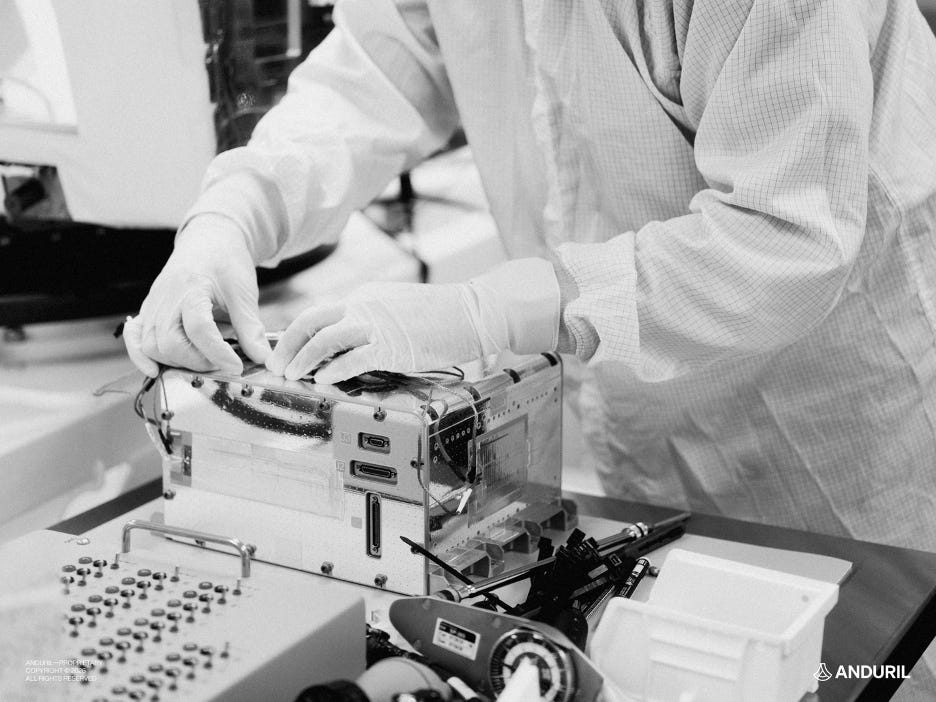
Anduril was actively building out its space team to tackle this challenge. The original five-person team on Jan expanded, pulling in new hires and people from across Anduril. Many took on roles they never had before. Infrastructure, procedures, and schedules all had to be established for the first time. Clean rooms had to be built. Machinery had to move into dedicated testing space alongside other Anduril product development. A brand-new operations center had to be established to bring command-and-control in house. All of it was being developed out of Anduril HQ in California at breakneck speed.
Inevitably, that meant trial and error. Space is hard. Extreme temperature swings, radiation exposure, and communications constraints all push systems to their limits. Despite this, failure wasn’t an option. This was communicated early and often to the team.
Testing relentlessly was the only way to achieve results quickly. But unlike terrestrial products at a test range, the margins for trialing space equipment are much higher risk. Once a system is deployed, there’s no going back. As one engineer put it, this meant “testing the living hell” out of every system before launch.
Testing & Integration
A couple months in, every system was complete: payload hardware, ground and flight software, electrical components. Building them individually was an accomplishment on its own, but it was the integration and test stage that would reveal whether they could actually communicate and function as a fully integrated spacecraft.
To do this, the space team took different components built by different teams and verified that they could function together as one system. Multiple engineers on the test team described this set of tasks as where the rubber met the road. They had no choice but to identify the problem, find the fix, implement the solution, and then test it all over again.
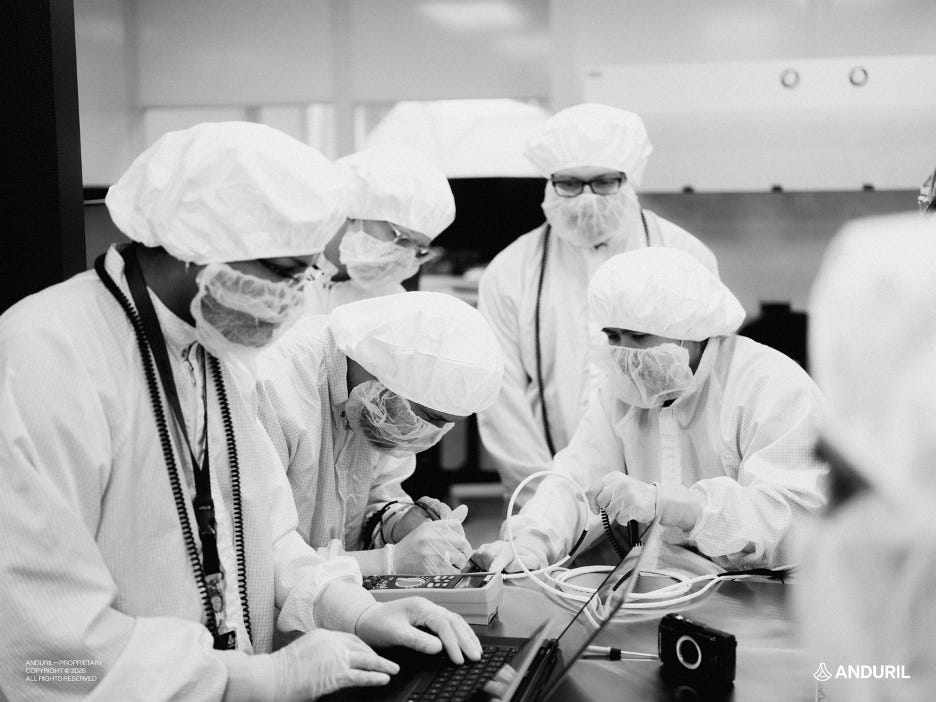
In the middle of the first test event, the team made it to phase six out of nine, the crucial stage when they would execute a full-image sequence with the payload. But they hit a blocker. The system needed to enter “snapshot” mode to image, and it failed every time it was attempted.
Engineers on the operations and payload teams worked extensively to diagnose the issues. They were resolved with repeated runs on the hardware test setup and a software update to the sensor flight unit. The full commissioning procedure was practiced multiple times, making incremental refinements along the way. By the second test, the work paid off: all systems were go. The stage was set for the biggest test yet: launch.
Launch Day & Early Operations
SpaceX’s Transporter-17 mission — Anduril’s ride to space — was scheduled to launch just after midnight Pacific Time from Vandenberg Space Force Base. Over at the Mission Operations Center (MOC) inside Anduril’s Costa Mesa headquarters, there was nervous energy among the first shift of operators. Soon, they would learn whether everything they had built, tested, and rehearsed would hold up in orbit.
Right before liftoff, a small group gathered atop the parking structure at Anduril HQ, hoping to catch a glimpse of the launch. Minutes later, the rocket’s bright plume streaked across the sky.

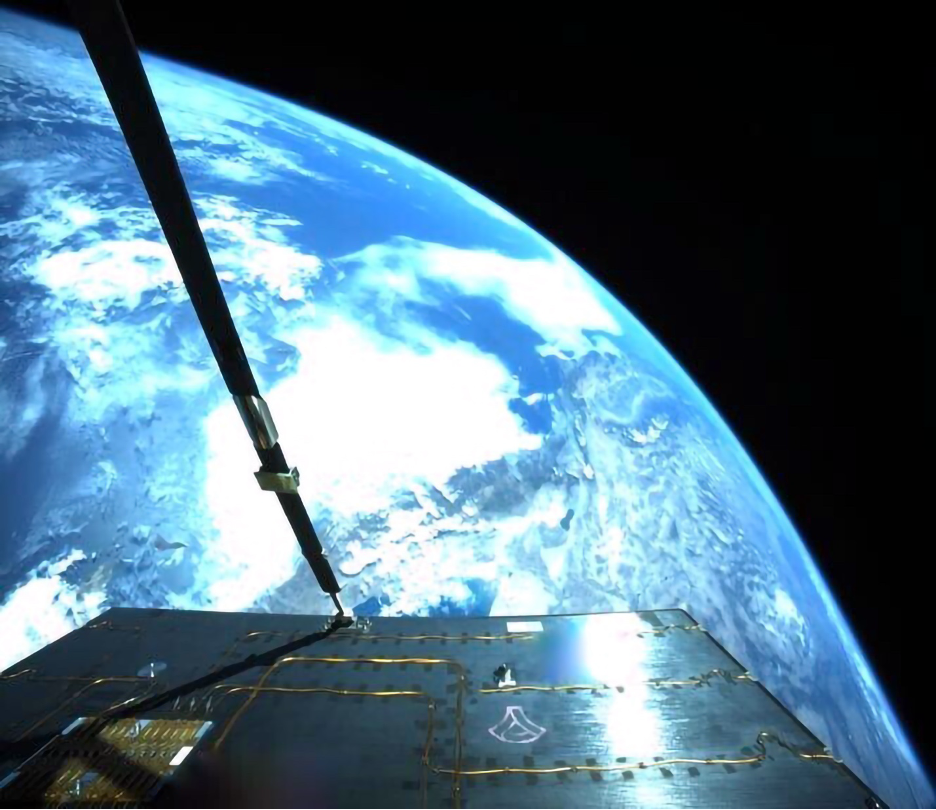
Soon, tension gave way to relief. The launch proceeded nominally. When the spacecraft separated from the rocket’s upper stage, cheers erupted. After everything it had taken to get there, the team had put a satellite in orbit.
Reaching orbit was one milestone; proving the spacecraft could perform came next. The first moment of truth would arrive almost 15 minutes after the vehicle separated from the upper stage and took its first pass over the ground antenna. The connection was weak. This wasn’t cause for panic—it’s not uncommon to have to wait for the next pass to establish communication. But then the next window passed and something worse happened —nothing. Then it happened again during the next cycle.
The room was tense. Repeated ground passes without establishing communication meant there was a serious problem that could jeopardize the entire mission. Sending commands, receiving telemetry, and downlinking mission data all relied on the spacecraft’s radio. But it was this exact scenario the team had prepared for during extensive testing, training, and rehearsals prior to launch. It launched into an all-hands-on deck effort, everyone dropped what they were doing to evaluate next steps. A collective call was made to switch to the backup radio.
Another agonizing 15 minutes, but this time, a different result: perfection. After a week of diagnostics, Anduril Space learned the issue with the radio was related to the thermal environment on orbit causing an intermittent failure and switched back to the primary once proper thermal mitigations were put in place.
Transitioning to routine operations confirmed Lectronimo’s longevity well past commissioning. Payloads continue to perform nominally, and each day on orbit gives the team more room to push further: deploying software updates, testing autonomous operations, and pulling down more imagery.

The Future of Anduril Space
If you ask the team about their proudest achievement in this saga, many answer simply: it’s that they avoided launching a dud on their first try.
But better than proving any business case, Lectronimo was a real-time technology demonstrator. It established an extendable architecture and set the foundation for future programs. The satellite will continue to serve as a testbed, allowing the team to push its systems further, test new capabilities, and apply lessons learned to whatever comes next.
Years before Anduril was a proper space company, its vision still pointed to the stars. Founder Palmer Luckey has talked about his ambitions for the domain over years. He recently told a group of Space Force Guardians the following:
“Our generation was born too late to explore the seas and too early to explore the stars. But we were born just in time to decide what we’re going to do in Low Earth Orbit and probably out to cislunar space. Let’s win the fight above the fight.”
The story of Lectronimo is part of Anduril’s theory of victory — and one small step toward winning the “fight above the fight.”
