

DARYL WIELAND is Senior Director of Partnerships at Palantir and an Adjunct Professor of Finance at George Mason University.
On February 24, 2022, Russia launched the largest land invasion in Europe since World War II. The prevailing consensus expected Ukraine to fold in seventy-two hours. Russian generals were killed at a rate suggesting their communications were compromised from the opening days. The Moskva, flagship of the Black Sea Fleet, was sunk by Ukrainian Neptune missiles operating on targeting intelligence that Ukraine likely didn’t develop alone.
The Ukrainians stood and fought. This was possible because of trust deposits made consistently and mostly invisibly in the eight years before Russia’s invasion.
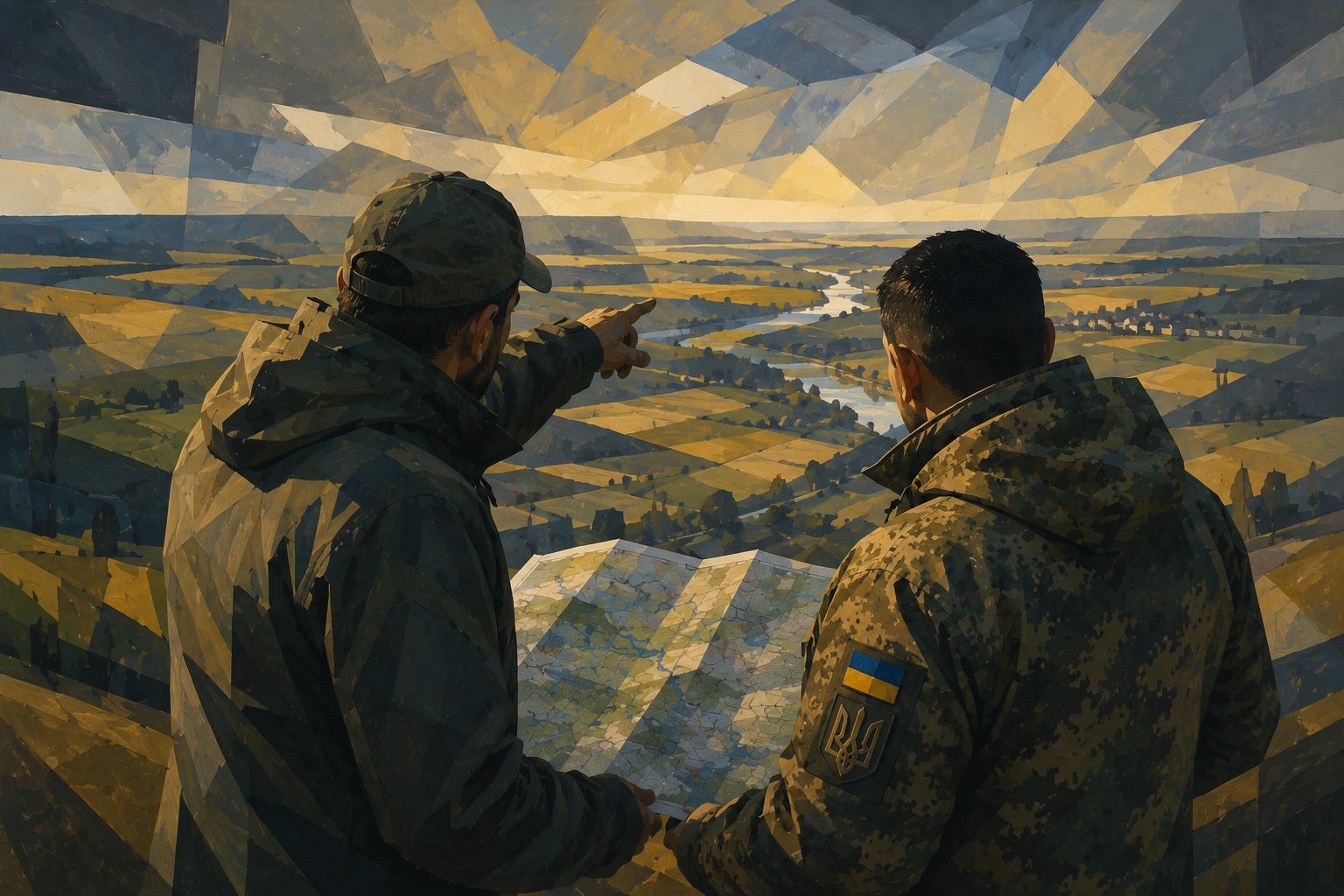
After the Maidan revolution in 2014, Western intelligence services began a sustained program of advising, training, and critically, sharing with their Ukrainian counterparts. They developed sources, methods, assessments, and institutional intimacy that comes from working through hard problems together over time. Western advisors embedded with Ukrainian units and ran joint exercises. They shared intelligence as an operating norm. The trust account was funded piecemeal, slowly but surely. The dividend was paid in the speed and precision of Ukraine’s early defense. By the time the first Russian columns crossed the border, the trust already existed.
That is the model for a true partnership. That is the bedrock it rests upon.
What Trust is Made Of
In their book The Trusted Advisor, Maister, Green, and Galford argue that trust is a combination of credibility, reliability, and intimacy. All three are undermined when people focus too much on themselves instead of on their potential partners. They were writing about client relationships, but the framework maps cleanly onto every partnership I’ve seen succeed or fail.
Credibility is whether I believe you know what you’re talking about. Reliability is whether you’ve done what you said you’d do, repeatedly, over time. Intimacy is whether I believe you can hold sensitive information: my fears, my failures, and my strategic uncertainties without weaponizing them. And self-orientation is the degree to which everything you do is ultimately about you.
Self-orientation is where most partnerships die.
Every day I see “partners” who are credible and reliable but have high self-orientation. The advice that conveniently aligns with their product roadmap. The consultant who identifies a problem that requires six more months of consulting to resolve. Self-orientation is the sand in the gearbox of every working relationship, and it grinds the teeth of the gears as the stakes get higher.
Character is Revealed, Not Trained
The Prussian concept of Auftragstaktik is built on the premise that trust can substitute for control. Give a subordinate the commander’s intent, not the instruction. Trust him to use his judgment and even improvise when circumstances change. But a self-oriented subordinate given mission-type autonomy is not an asset; rather he is a liability who will optimize for his own narrow goals and call it “professional judgment.”
The Western advisory effort in Ukraine functioned on the same logic. Advisors built the institutional capacity for Ukrainians to decide faster and better. The advisor’s job was to help the Ukrainians learn to use that capacity themselves instead of relying on Western decision-making. By February 2022, they had.
The Ukrainians demonstrated the character and competence to persevere. Both character and competence are necessary, but they are not of equal value. An incompetent partner with high character can be developed. An extraordinarily competent partner with low character is a trap.
It takes more than a kickoff meeting to establish trust. It tends to be established in uncomfortable moments. For example, finishing up the deliverable before midnight because the deadline mattered or telling the difficult truth when a comfortable omission was available. One failure can cancel multiple exemplary performances in the psychological ledger of trust. If I cannot predict your behavior under pressure, I will stop depending on you when the stakes matter.
Character is what makes intimacy possible, because you can’t be strategically vulnerable with someone whose character you can’t trust.
The Vulnerability Threshold
I share with account teams all the time that if you partner with someone who has the same capabilities as you, acts like you, and has the same experience as you, it is unlikely to end well. You will trip all over each other as you both have the same strengths. You will also continue to have capability gaps. Rather, a thorough make/buy/ally analysis where you decide what to build yourself, what to purchase, and what to pursue through partnership is critical in defining the partner who fills your capability gaps. This probably means the partner has a different set of experiences. Likely they approach the problem from a different point of view. This will be uncomfortable and confusing at times. It can also get you to places that you can’t get to on your own.
Successful partnerships require vulnerability. You need to allow a partner to see the constraints you are operating under, the strategic bets that might not pay off, and the fears you carry into every major decision. Most partnerships mistake lavish dinners or offsite team building events for intimacy, but these social experiences can’t be weaponized because there is nothing at risk.
Strategic intimacy is different. It is letting a partner see the thing you’re most afraid won’t work. The first move is always unilateral. You share before you know if it will be reciprocated.
This is exactly what happened with Ukraine. Early in the post-2014 period, Western partners had to make a judgment call about whether they should share sensitive collection methods with a country whose own institutions were still being reformed, knowing that a single compromise could put sources at risk across an entire theater. They shared anyway, deliberately. The Ukrainians reciprocated by protecting what they received, and over time both sides raised the threshold of what they were willing to share. By the time it mattered, intelligence could flow at the speed of operations rather than the speed of bureaucracy.
It takes courage to be vulnerable. It takes low self-orientation to absorb a partner’s vulnerability without exploiting it. Credibility and reliability can produce a functional working relationship. Only intimacy allows a partner to know what you need before you ask.
The Defense Industrial Base: Where Trust Gets Tested
This lesson is as applicable in business as on the battlefield.
The relationship between established defense primes and emerging defense technology companies is, in theory, a natural partnership. Primes have scale, contract vehicles, and knowledge of the Pentagon’s procurement labyrinth. New entrants have speed, innovation, and the willingness to build capabilities the primes can’t or won’t build themselves. Each has what the other needs and yet in practice, there is a high failure rate.
The Valley of Death is real for startups. In the typical prime partnership model, the focus is on securing a single piece of IP or component rather than supporting the company that created it, giving primes little reason to invest in the startup’s broader success.
The pattern is familiar. Through tech scouting, a prime identifies a startup with a compelling capability. There is enthusiasm, an MOU, maybe even a joint demo. Then the startup discovers that the prime’s integration timeline is measured in years. The prime discovers the startup has fourteen employees and no experience in managing a subcontract data requirements list. The MOU gathers dust. The capability gap persists. The prime’s internal antibodies re-emerge arguing that if their engineers were just given the money, they could build it themselves.
The problem is almost always self-orientation. The prime treats the startup as a subcontractor to be managed rather than a partner to be developed. The startup treats the prime as a piggy bank rather than an institution with legitimate constraints.
To do this differently you need to be willing to be vulnerable. This means following through with small commitments such as quickly responding to email, making the promised introduction, and delivering the test environment on time. One of the hardest steps is the honest disclosure of constraints. For a startup, that means transparency about burn rate and the features that aren’t ready yet. For a prime, it means candor about internal politics with the engineering team that affect the partnership decision.
The prime that mentors a startup through its first classified integration by sharing lessons learned, making introductions, providing honest feedback is making the same kind of trust deposits the Western advisors made in Ukraine. When a crisis emerges and the Pentagon needs a capability fielded in months, the prime with a network of partners who are already integrated will deploy while competitors are still negotiating teaming agreements.
Bedrock Takes Time
The Ukrainians built their intelligence partnerships over years of patient and often unglamorous work. They participated in joint exercises that no one heard about. They made institutional reforms that took years to show results. They were willing to be transparent about what they didn’t know. When the crisis came, the bedrock held firm.
Trust is an operational capability. It is built in small deposits and spent in large withdrawals. The question is whether you are willing to start making deposits now before you know what crisis will demand the withdrawal.
