


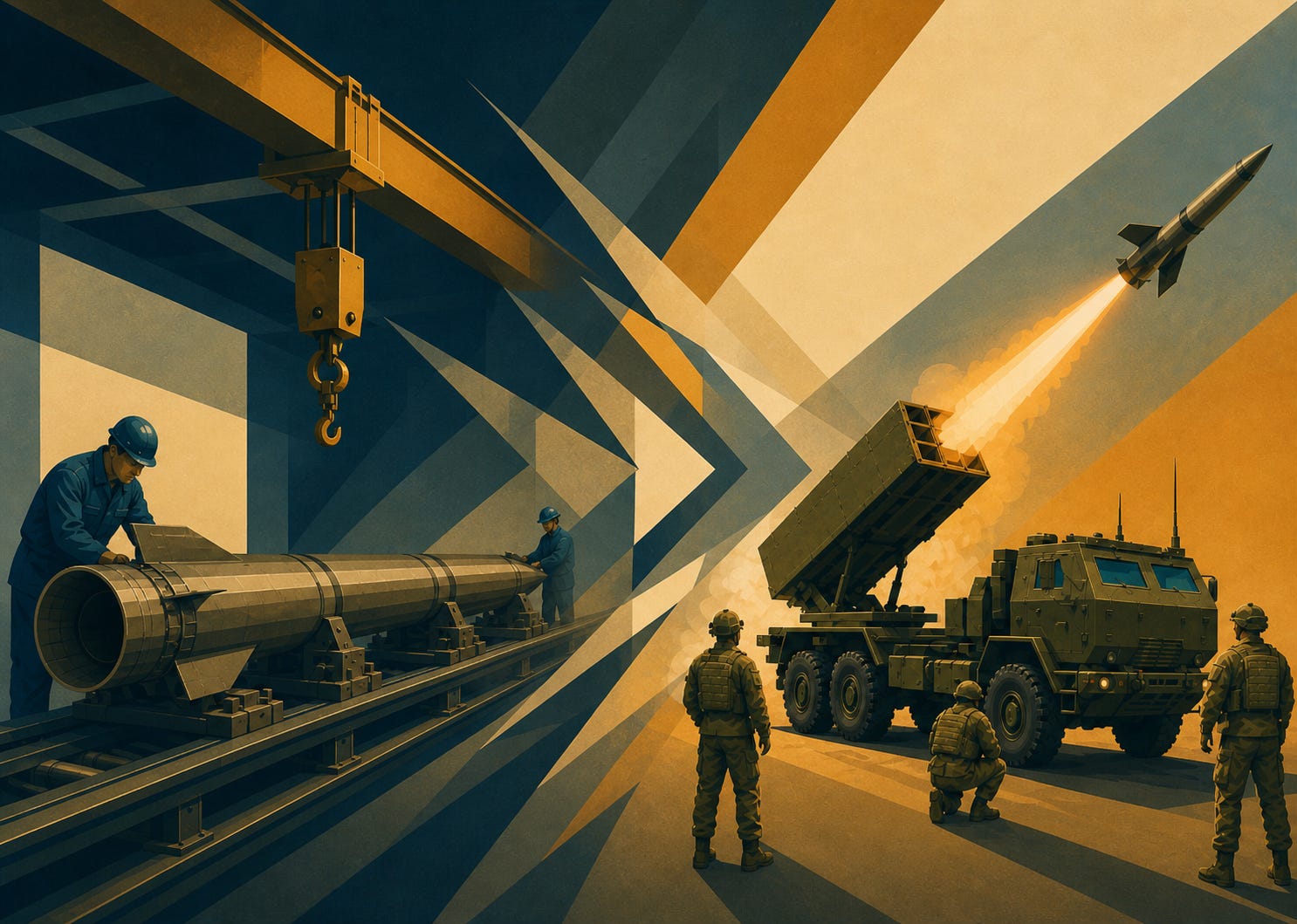
We often default to a particular version of World War II. It’s the one everyone knows: D-Day, carrier battles in the Pacific, armored divisions pushing across Europe. It’s a story about tactics and decisive moments. The Band of Brothers war, you could call it.
But a lot of the war was decided somewhere else entirely. In places like Detroit and Pittsburgh, production lines ran around the clock and output became the limiting factor of what was possible on the battlefield. It was factories that determined the pace and scale of the fight.
When Franklin D. Roosevelt called the United States the “Arsenal of Democracy,” he was describing how the system actually worked. Combat power started in the factory and manifested on the battlefield. We understood that then. We don’t operate that way now.
Today, the conversation is centered on command and control decision advantage—how quickly we can move from sensing to decision to action. Systems like CJADC2 are built around that idea, emphasizing faster decisions, tighter OODA loops, and more connected forces. That matters, but in today’s word it’s not the constraint most people think it is. Just look at CENTCOM, which has executed over a thousand targets a day in Operation Epic Fury.
The constraint is production, and you can see it in how we fight today. It’s entirely possible to have a good operational picture and still not have a clear answer to basic questions like: how many munitions do we have ready right now? How many munitions can we produce? The data exists, but it’s spread across systems, updated on different timelines, and owned by different organizations. Instead of seeing the answer, we assemble it, which slows everything down in ways that only become clear in the fog of war.
One part of the system moves at machine speed, while another part moves at human speed. We’ve built a very good kill chain, but we haven’t built the equivalent system for production and sustainment. Once the opening phase passes, the question changes from who can strike first to who can keep going—who can replace what they use, shift production, and absorb disruption.
Enter WAR MACHINE
The solution is to build a system that enables real visibility and control of defense industrial supply chains and production. We call this WAR MACHINE. It’s not a program or a piece of software, but a way of looking at the system as a whole. The factory, the suppliers, the depots, the logistics network, and the units using the equipment are all part of the same system. When one part slows down or breaks, the machine doesn’t work as it should.
Right now, those parts don’t operate as one system. The primes have their own view, sub-tier suppliers have another, and the government has a third. Each one sees a slice, but no one sees the whole picture in real time, which makes it difficult to answer straightforward questions about constraints, bottlenecks, and spikes in demand.
It also changes the dynamic between the Department and industry. Rather than wield the industrial base, the Department is at its mercy. The DoW often has less visibility into a given program’s supply chain than industry. That’s an unacceptable status quo during peacetime, and it becomes existential during a conflict. It’s ironic that the DoW requires defense contractors to open up their books and comply with Cost Accounting Standards so auditors can pore over pennies, yet it does not apply the same scrutiny to the area that would really make a difference: production. Visibility into a weapon system’s production should be a requirement, just like payload capacity, range, or accuracy.
You hear the pushback on this proposal almost immediately: the Department shouldn’t have this level of visibility into industry, lest it overreach and cross a line into controlling how companies operate. Such an argument ignores how competitive hardware products are manufactured in the commercial economy. Apple does not take a laissez faire approach towards its suppliers. Quite the opposite. Apple rear deploys its engineers to all of its suppliers. It’s a similar story with the automotive OEMs and their relationship to the Tier II and Tier III suppliers. It’s helpful to think of Apple and the auto companies as the first customers of their products. Demanding factory floor visibility from their suppliers is a matter of customer service. It follows that when the stakes are higher than luxury goods, the DoW should not operate in the dark for life-and-death production runs of artillery.
The reality is that the defense industry’s truculence on this issue is a bit of “the lady doth protest too much.” The defense companies themselves often have poor visibility into their own supply chains and are none too eager to expose such a state to their customer. In turn, suppliers to the defense companies are often reluctant to disclose bad news like parts delays. All the more reason for the DoW to demand more of industry as a forcing function to make the entire industrial base more effective.
There’s a carrot in there for industry as well. Today, companies are often planning production against incomplete or lagging signals from the government—uncertain demand, shifting priorities, and funding volatility all get in the way of making clean decisions. We ask industry to surge, but we don’t give it a clear picture of what “surge” actually means over time. A system that connects the Department to its industrial base would not only give government visibility into supply, it would also give industry visibility into demand, allowing both sides to operate off the same reality instead of two different approximations.
Recent operations make the visibility gap harder to ignore. In Operation Epic Fury, U.S. and partner forces executed one of the most intense strike campaigns in decades, consuming large quantities of precision munitions across multiple systems. The operational side performed exactly as designed—fast, coordinated, and effective. But significant portions of key munitions inventories were depleted, and rebuilding those stockpiles will take years, in some cases.
Innovation in bits advanced faster than atoms, which means awareness and targeting far outpace production capacity. The limiting factor is whether the industrial base can regenerate combat power at the pace the fight demands. The next conflict—especially if it’s in the Indo-Pacific—is unlikely to be a brief exchange. It will be defined by distance, scale, and sustained demand across air, maritime, and missile systems. It will stress supply chains in ways we haven’t experienced ever. It will expose every fragile node, every single-source dependency, and every place where production can’t keep up.
Industrial Power is Combat Power
In World War II, the solution was alignment. The entire system—government, industry, and workforce—moved in the same direction. Arthur Herman’s Freedom's Forge captures how leaders like William S. Knudsen and Henry J. Kaiser coordinated production across companies and supply chains. It wasn’t elegant, but it worked because the factory and the front line were part of the same system.
We’ve seen a version of this play out in the commercial world, as well. In the book American Icon, turnaround CEO Alan Mulally walked into Ford Motor Company when it was close to failure. One of the first things he did was force visibility across the enterprise and into the supply base. Ford soon understood what was happening inside its operations and across its suppliers, issues surfaced early, and leaders could act before problems cascaded. That shift—seeing the system clearly and acting on it—was a big part of what kept Ford from going bankrupt, even while General Motors and Chrysler went under.
This is the shift the Department needs to make. Creating a system that sees itself clearly enough to act transcends building more reports or better dashboards. We must connect production, supply, and sustainment the same way we’ve connected sensors and shooters, so that constraints are visible early and decisions about tradeoffs can be made with a full picture instead of partial views stitched together over time.
The underlying point is straightforward: industrial power is combat power. In a conflict that lasts more than a few weeks, the side that wins is the one that can keep producing, keep adapting, and keep supplying its forces under pressure. The path from factory to foxhole is as much a part of the fight as any kinetic action.
Right now, many still assume the industrial base will keep up, supply chains will hold, and production will surge when the time comes. Operation Epic Fury proved those assumptions false. WAR MACHINE is the system we need to build now if we expect to fight, sustain, and win any future conflict.