Peter Mitchell is a U.S. Army officer and former instructor of strategy at the U.S. Military Academy at West Point. His novel Captain Hawke will be released this summer. He has also written an adventure following a young Clausewitz, a story that, much like Scharnhorst’s early efforts, is still searching for its breakthrough. Follow him on X @peternmitchell.
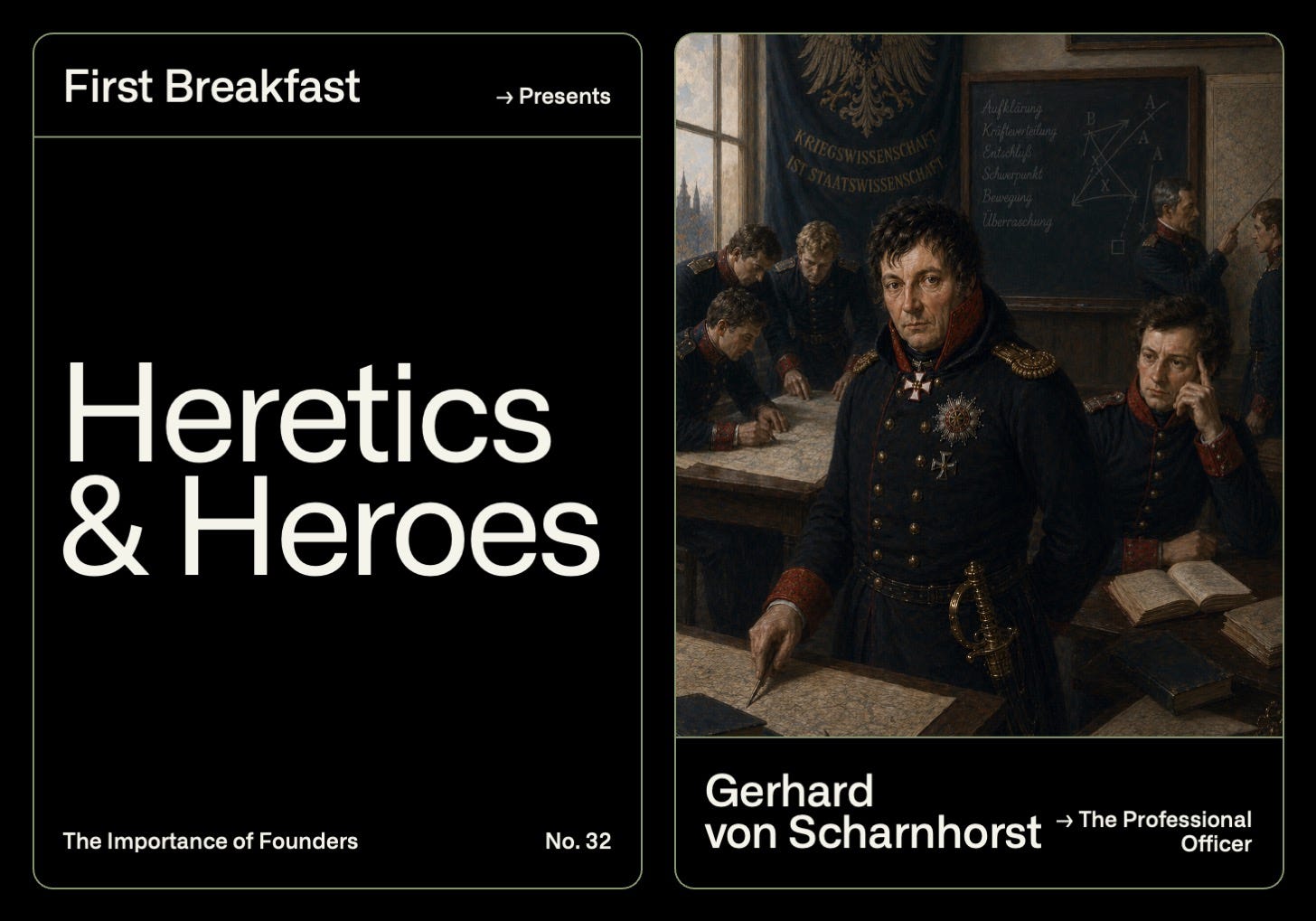
In 1801, a Hanover-born artillery officer named Gerhard Scharnhorst arrived in Berlin with an unusual mission from the King of Prussia: he was tasked with making the Prussian Army think.
This was, at the time, a revolutionary act.
Quite literally—people thought he was a crypto-republican.
Prussia in 1801 was (to her officers’ minds) already perfect. Her army was the most storied in Europe. It stood upon the legacy of Frederick the Great, who had died in 1786 having won wars that defied all considerations of manpower and geography. Prussian officers still dressed after his fashion, drilled in his formations, and repeated his maxims as gospel. The army had become a living museum, and in such a place as that the most dangerous thing an officer can do is suggest that the exhibits be removed.
Gerhard Scharnhorst was just such a man.
The Parade Army
To understand what Scharnhorst was up against, you have to understand how badly the Prussian Army had stagnated by the dawn of the nineteenth century. Structurally, it was still the army of Rossbach and Leuthen of five decades before: fighting in rigid linear formations with brutal drill discipline enforced by the rod. Officers were selected by birth rather than ability and operated in a command culture that punished initiative as a form of insubordination. The enlisted ranks were filled with levied peasants, criminals, vagabonds, and foreign mercenaries held together through coercion rather than cohesion. The whole edifice assumed that war would obligingly be fought by the same immutable Frederician script.
However, Napoleon Bonaparte had written a new one.
South of the Alps, France had spent the better part of a decade kicking the armies of the old order up and down the Po Valley. The levée en masse had mobilized the whole of French society and replaced small, professional Ancien Regime armies with conscripted citizens on a scale far greater than the traditional Prussian canton system. French corps operated semi-independently, foraging off the land, moving faster than a traditional supply train could follow. Commanders were selected by merit and ruthlessly replaced when they failed. The French Republic was forging fundamentally different methods of modern war.
The Prussian high command watched all of this and shrugged chauvinistically. Even after the Prussian defeat at Valmy in 1792, France’s further successes against Austria and the smaller German states were attributed to luck, revolutionary fervor (a temporary condition, surely), and the perceived incompetence of Prussia’s Habsburg rivals. The institutional conclusions that should have followed were systematically suppressed by an officer corps whose identities, social status, and economic livelihoods were intertwined with the existing system. Admitting that the system was broken meant admitting that they were, too.
The Outsider’s Audit
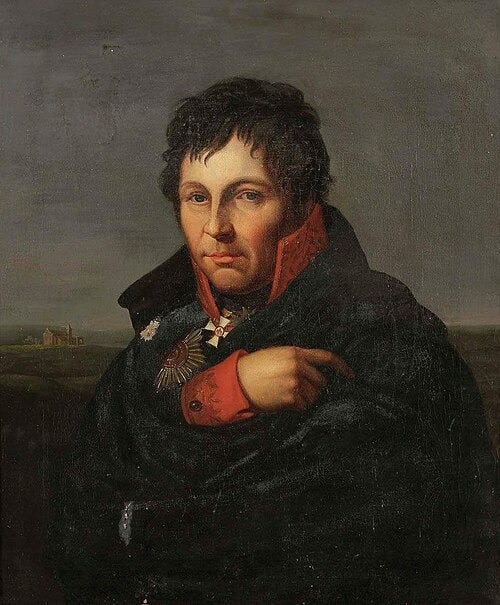
Scharnhorst understood the Prussian problem because he was not quite one of them. Born in 1755 to a family of modest Hanoverian freeholders he had no aristocratic sinecure to protect. He had earned every position through demonstrated intellectual and professional ability, which made him unusual in every army in which he served. He joined the Hanoverian artillery, studied obsessively, and began publishing his own military journal in the late 1770s when he was barely in his twenties. By the time he was a first lieutenant, he had already written more seriously about the theory of war than most generals had read. But Scharnhorst was no desk jockey. When the wars of the French Revolution erupted in 1789, he joined the Hanoverian Expeditionary Corps under Prince Frederick, Duke of York and fought with great distinction in the Netherlands.
Prussia’s Frederick William III recognized something in Scharnhorst. In 1797, Prussia invited him to the kingdom with an offer of a promotion to lieutenant colonel. Scharnhorst demurred, preferring to stay in Hannover with his writing and his wife Clara. In 1801, the King of Prussia invited him again to Berlin with the promise of a nobility patent (making him Gerhard ‘von’ Scharnhorst), a double salary, and a promotion to colonel.
This time Scharnhorst accepted and moved with his wife to Berlin, where the king appointed him to lead the newly founded Akademie für junge Offiziere der Infanterie und Kavallerie. It was an experiment in building what we would now call institutional knowledge. Scharnhorst occupied a townhouse on the prestigious Unter den Linden boulevard and put out a request for regiments to send him their best and brightest young officers to teach them the art of war. He meant to expose them to that which the Prussian military had rarely prioritized: serious, critical thought about why armies won and lost, not just how they maneuvered and fought. He also started a seminar known as the Militärische Gesellschaft or “Military Society” for similarly aligned officers such as the brilliant August von Gneisenau.
The old guard was not pleased. To men like Field Marshall Wichard von Möllendorf, the Akademie looked very suspicious. A boondoggle. Officers who asked too many questions were dangerous. Officers who read theory were practically treasonous. The aristocratic establishment that ran Prussia’s military viewed Scharnhorst’s project as an irritant at best. At worst, they feared it was a seditious little intellectual club that—even if it wasn’t fomenting republicanism—would certainly produce nothing useful for the real business of war.
The Prussian general of the day would have heartily agreed with Britain’s Prince George, Duke of Cambridge, when he asserted: “Brains? I don’t believe in brains! You haven’t any, I know, sir! There is a time for everything, and the time for change is when you can no longer help it.”
So Möllendorf and the other generals kept Scharnhorst far away from any influence over doctrine, procurement, or command selection. Only a handful of young ensigns and cornets were sent to the Akademie, largely outcasts that the colonels didn’t mind losing to their young king’s eccentric project.
Let the Hanoverian Colonel Scharnhorst have his cadets and run his Francophilic seminar. He could not actually change anything that mattered.
The Star Student No One Wanted
One of the young officers Scharnhorst received was a twenty-one-year-old lieutenant from Prince Ferdinand’s 34th Infantry Regiment named Carl von Clausewitz—a young man who, by almost every conventional Prussian measure, had no business being in the room.
Lieutenant Clausewitz was from Magdeburg. His father was a minor civil servant and former officer, technically of noble birth, but he had retired from the army at the same time as Frederick the Great’s purge of non-noble officers. Clausewitz’s tenuous claim to his “von” (along with his suspiciously Slavic-sounding surname) led to loud questions from officers with family lines stretching back before the foundation of Prussia.
To make matters worse, Clausewitz was socially awkward, bookish, and possessed of a neurodivergent intensity that made him deeply unsuited for both small talk and the glad-handing politics of the regimental mess. He did not mesh well with the kind of men who ran things. He had earned a battlefield commission during the Siege of Mainz in 1794. He had no patrons, no family connections to command, no path to preferment.
What he did have was an extraordinary mind.
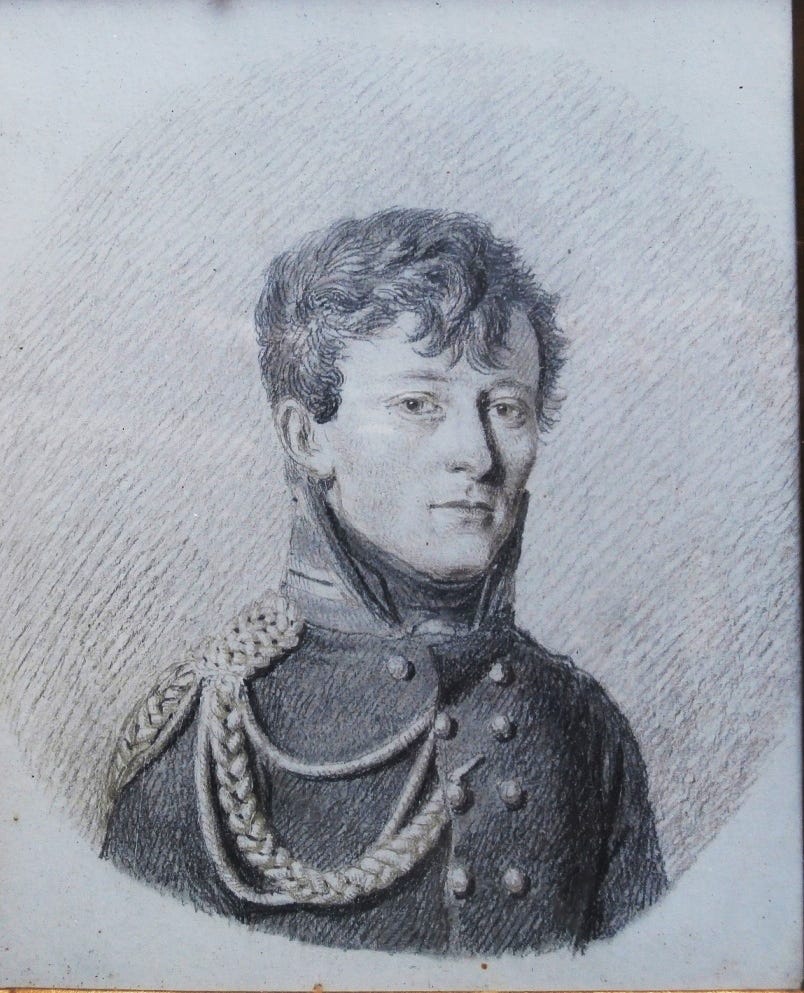
Scharnhorst saw it immediately. He took Clausewitz under his wing, guided his reading, sharpened his thinking, and (critically) advocated for him in the face of a system that would have been happy to leave him in obscurity. When Clausewitz’s noble credentials were challenged in 1803, Scharnhorst intervened with the king to arrange for Clausewitz to be made aide-de-camp to Prince August. He used personal capital that a more self-interested man would have husbanded carefully. He spent it on a young man his colleagues considered more trouble than he was worth.
Scharnhorst had grasped something the establishment was incapable of grasping: that the asset which would determine Prussia’s future military effectiveness was not the bayonet or the battalion square, but the caliber of mind that could understand war well enough to adapt to it in real time. He was building intellectual infrastructure.
The institution, for the moment, was entirely uninterested.
The Prussian Blue Screen of Death
On October 14, 1806, the parade ground army met the real thing at the twin battles of Jena and Auerstedt.
In a single day, Napoleon’s forces completely destroyed the Prussian field army of 70,000 men. Prussian formations that had drilled for years dissolved. Commanders who had been promoted for lineage rather than ability fought with tremendous bravery and failed in ways that were, in retrospect, entirely predictable. The rigidity that the old guard had mistaken for discipline became a death sentence when the French corps commander Louis-Nicolas Davout improvised, flanked, and refused to fight on Prussian terms.
The commander of the Prussian main body, the Duke of Brunswick, was shot in the head while trying to rally his grenadiers and killed. As the main body fell back in disarray, they ran smack into the Prussian vanguard, which was fleeing north as fast as they could from Napoleon and four other French corps.
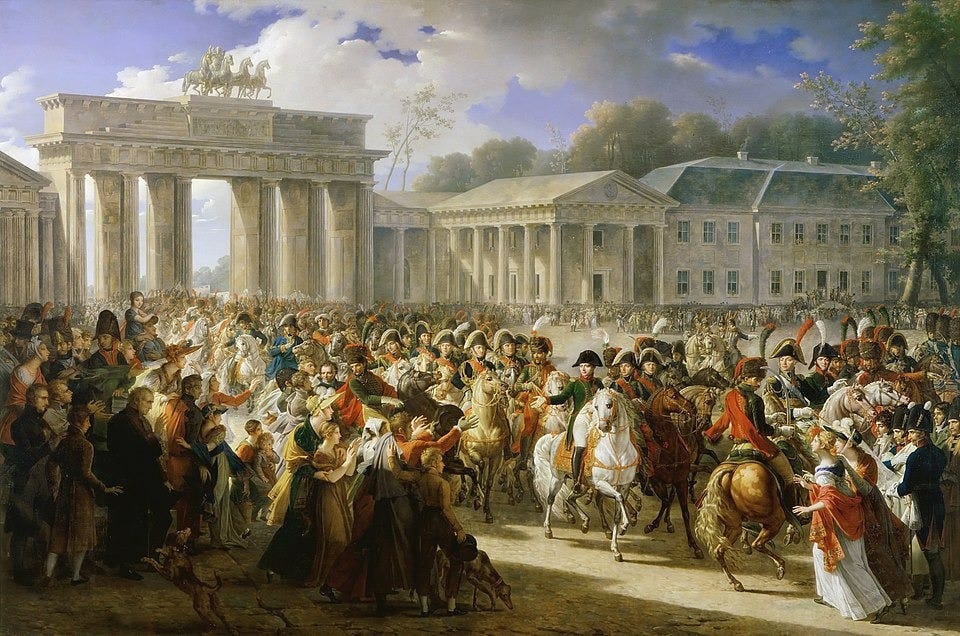
Within three weeks, the Kingdom of Prussia was prostrate. French troops occupied Berlin. The king fled east to Königsberg. The army that had been the terror of Europe for sixty years had been broken faster than anyone thought possible in a humiliation greater even than Austerlitz.
Scharnhorst, who had argued for years that a reckoning like this was coming, was given command of the rear guard and was wounded in the subsequent holding action to buy time for the king to escape. He was then assigned to manage the armistice negotiations.
Lieutenant Clausewitz spent a year as a prisoner of war before being exchanged.
The Seeds and the Sower
Here is the part of the story that matters most: Scharnhorst’s post-Jena reforms were not built from scratch.
Scharnhorst’s Militärische Gesellschaft had produced a cohort of officers that understood that Prussia’s loss was not a question of bravery or morale. It was the result of a structural failure. These men had read military history, studied Napoleon’s campaigns, and learned to ask hard questions rather than reflexively defer to seniority. Scharnhorst now had something to work with. The King of Prussia made him a general and gave him carte blanche to reform the army.
The reforms Scharnhorst rammed through between 1807 and his death in 1813 were sweeping: the abolition of corporal punishment; the transformation of the Akademie für junge Offiziere into the famous Prussian Kriegsakademie, the war college that would produce professionally educated officers for generations; the opening of commissions to non-nobles on the basis of merit; and the development of the Landwehr, a reserve system that could mobilize the nation’s manpower beyond just the standing army. He also pushed for the development of the general staff as an institutional brain trust rather than a collection of royal favorites—a concept so foreign that it required the complete destruction of the old system to implement.
Major Clausewitz completed the transformation, becoming the superintendent of the Kriegsakademie from 1818 to 1830. The thinking he had done under Scharnhorst’s guidance was refined over years of study and tested against the catastrophe of 1806. Clausewitz, with the extensive help of his loving and very patient wife Marie, produced On War, the most important work of strategic theory in the Western canon.
The Prussian army that defeated Napoleon at Waterloo in 1815 and the Prussian state that became the dominant power in Europe by 1871 (along with the modern United States officer corps) stood on the foundation Scharnhorst laid before anyone thought a foundation was needed.
What This Means for Today
Scharnhorst’s life is a story about the cost of institutional complacency and the mechanism by which that cost eventually gets paid.
The Prussian officer of 1805 was not stupid. He was not a coward. He was a rational actor operating within a system that rewarded the perpetuation of existing structures over honest assessment of emerging threats. The incentives ran in exactly the wrong direction. The intelligence was there. The information was available. The analytical capacity existed—somewhere—in the system. But the institutional architecture was built to filter it out.
Scharnhorst’s answer was to build a parallel infrastructure—a small, underfunded, politically marginal military academy—and populate it with aligned men who had no vested interest in defending the existing answers. He could not reform the institution from the inside through persuasion; it was too well-defended for that. He built the capability that the institution would need when it finally had no choice but to change.
Armies, governments, and industries have always preferred the comfortable illusion that existing structures can be changed when needed over the expensive, politically fraught work of building what is needed in advance. The Prussian high command of 1805 was certain that its machine would perform when called upon. Its failure was comprehensive, rapid, and very nearly fatal.
The problem that the West faces today is a version of the same. The systems, processes, and procurement cultures built for a post-Cold War world of limited contingencies and leisurely acquisition cycles are not suited to the current environment. The gap between what existing architecture can deliver and what the moment requires is widening. The Jenas of the next decade will not announce themselves in advance.
Scharnhorst did not wait for Jena to start building the Kriegsakademie. He started five years before with a handful of students and a small budget.
That is the lesson. Not the dramatic rebuild after the disaster, but quiet, stubborn investment in the face of institutional intransigence.
The Prussian Army eventually got its reformation, but the cost of waiting was severe and entirely avoidable.
Gerhard von Scharnhorst knew that. He said so, repeatedly, before anyone cared to hear it.
That’s the sort of vision after which warships are named.